
Interior design project management software helps you coordinate all the phases of interior design projects — from the initial client consultation to the final setup of their brand-new space.
Small studios can finally let go of chasing approvals across emails or order tracking chaos, as everything is easily managed in one single place.
I’ve tested 6 of the most popular project management software for interior designers that offer free trials. Keep reading to discover what each of them is best for and find your perfect match!
WHY TRUST US?
The apps we talk about are selected, tested, and written about by human reviewers who follow strict review and editorial guidelines. We pick solutions that are practical, purposeful, and can offer real value for the specific use case or business context we’re covering — while also being justified in their pricing. Our methodology is transparent, clear, and available to everyone:
What is interior design project management software?
Simply put, interior design project management software is a platform that helps interior designers streamline both business and creative activities.
You have one workspace where you can:
- Coordinate the design team and delegate tasks.
- Keep track of progress and deliverables.
- Communicate with the team.
- Set and track deadlines.
- Store and share files, and more.
Still, the main point of design management software is to use the same space where designers can also deal with specifics, including:
- FF&E schedules
- Procurement management
- Client approvals
- Invoicing
The 6 best interior design project management tools (2026): A quick overview
Before we dive into the detailed reviews, check out the summary below for some basic info on the 6 platforms I tested:
| Tool | Best for | Free trial | Free plan | Lowest price |
|---|---|---|---|---|
| Plaky by CAKE.com | Beginner-friendly interior design project management | ✔️ | ✔️ | $3.99/seat/month (billed annually) |
| Design Manager | Interior design advanced accounting | ✔️ | ❌ | $79/user/month (billed monthly) |
| Programa | Procurement and order management | ✔️ | ❌ | $63/seat/month + $31/seat/month for every additional seat (billed annually) |
| DesignFiles | Creating moodboards and 3D floor plans | ✔️ | ❌ | $55/user/month + $30/user/month for every additional user (billed monthly) |
| Floorplanner | Quick 2D and 3D floor plans | ❌ | ✔️ | $5/user/month (individual users)$59/user/month (up to 10 users) |
| Planify | Client collaboration | ✔️ | ❌ | $24.49/month (billed annually) |
#1 Plaky by CAKE.com — best for beginner-friendly interior design project management
Plaky is simple and affordable interior design project management software that helps individual designers and studios handle tasks, coordinate design teams, and keep project documentation in one centralized space.
Why choose Plaky?
Plaky is a beginner-friendly, highly customizable tool that lets you easily adapt your workspace to your creative workflow.
| Pros | Cons |
|---|---|
| – User-friendly – Highly-customizable – Unlimited users, storage and tasks – Affordable | – Limited integrations |
As soon as you set up Plaky, you’ll notice it’s easy to use. There’s no learning curve, which is a real plus for interior designers, if you ask me. You can quickly learn the ropes and focus on the actual work — without spending much time on onboarding complex software.
There are several points where Plaky really stands out:
- Task management — organize daily to-dos in detail by using custom Fields to add assignees and reviewers, set deadlines, track budget and approvals, etc.
- Clear hierarchy — use Spaces, Boards, Item Groups, Folders, and (Sub)Items to keep work granular.
- File-sharing and unlimited storage options — store, organize, and manage all sorts of files in one centralized location.
- Unlimited-seats free plan — if you’ve just started your interior design studio or are a solo designer, Plaky’s free plan offers unlimited users, tasks, spaces, and boards as well as 10 MB storage per file to manage your projects at no cost.
- Affordable pricing — from a generous Free plan to the cost-efficient Enterprise option, Plaky can handle both simple and complex projects.
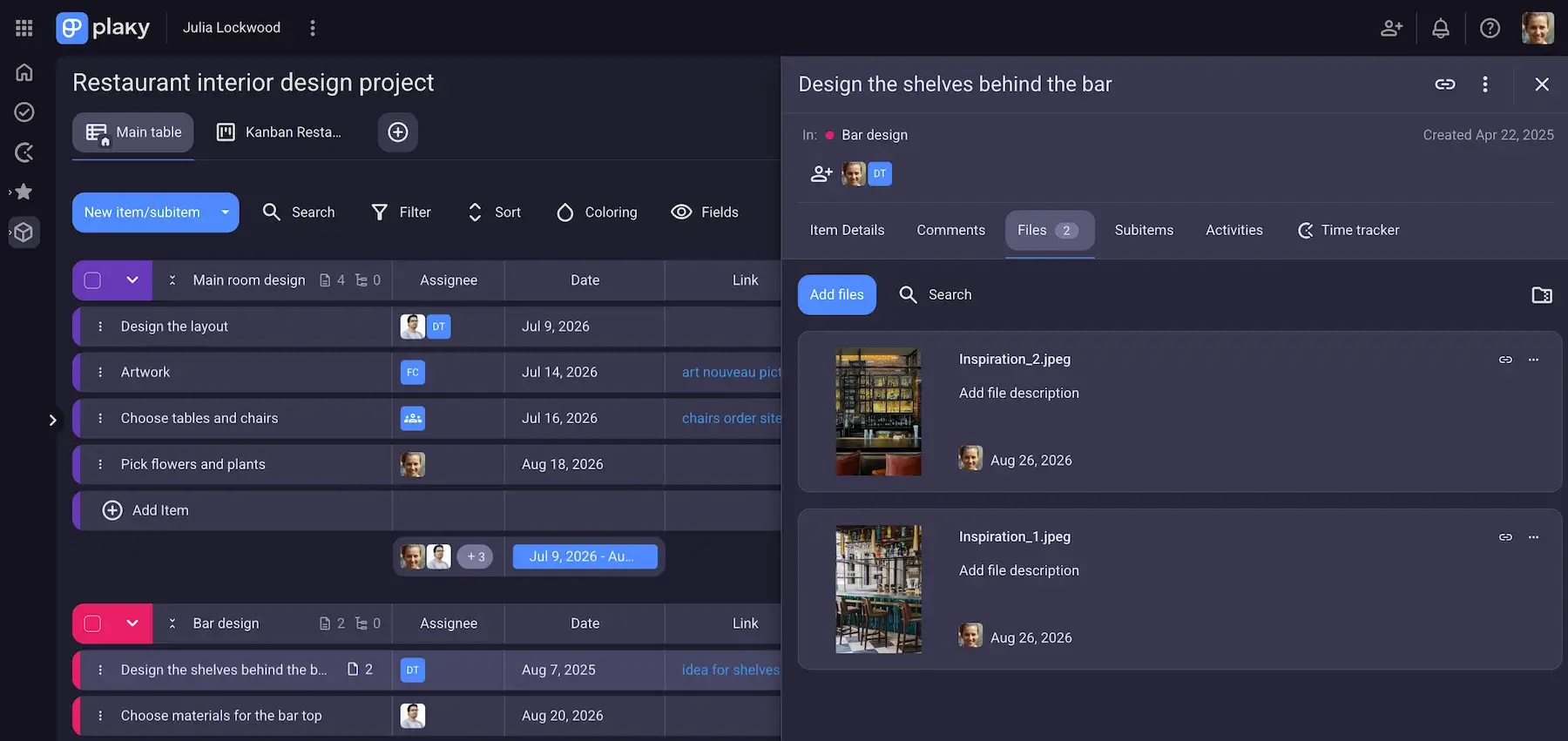
When it comes to handling creative projects, Plaky helps you:
- Track progress — monitor your interior design workflow, and see the status of the tasks using different board views such as spreadsheet-like Table view or Gantt chart view.
- Manage deadlines and statuses — define due dates for every task, and set color-coded statuses to identify the stage of each task and streamline the review and approval process.
- Control procurement — create a list of goods, services, and vendors, note down specifications and quality requirements, allocate funds, and monitor delivery and adherence to budget.
- Centralize collaboration — use Comments to exchange ideas, give feedback, and @mention team members, and get Notifications on changes and updates directly in Plaky, so you never miss a thing.
- Invite viewers to your boards — give clients read-only access to your project boards for free so that they can see progress and available data.
- Automate workflows — use trigger-based board automations (like assigning a reviewer when the task status changes, creating recurring tasks, sending reminders about approaching due dates, etc.) to reduce manual work and streamline processes.
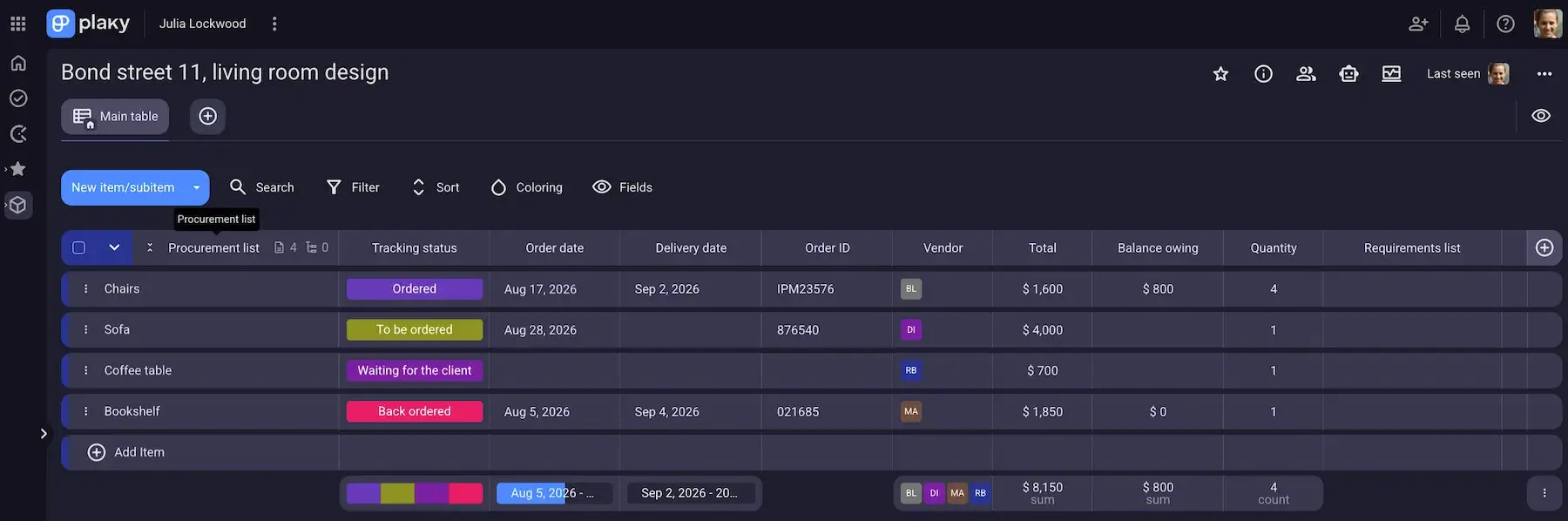
If you want to avoid overly complex or expensive interior design business software, Plaky can be your go-to tool to manage projects, create FF&E-style item lists, track order statuses, and more.
However, there’s one area where Plaky could improve and that is integrations with popular tools used in the interior design field.
Still, I wouldn’t cross Plaky off the list that easily because, as a part of CAKE.com’s Productivity Suite, it natively integrates with other CAKE.com apps. So, you can make use of:
- Plaky + Clockify integration — create a Clockify account free of charge to get a Clockify timer in your Plaky Items so that you can run time reports, estimate project costs, and keep billable and non-billable work data accurate.
- Plaky + Pumble integration — get Plaky notifications directly in Pumble to stay up-to-date without the need to switch tools.
You can also benefit from Plaky’s API, as it lets you generate an API key to connect this tool with other apps you work with.
What’s new in Plaky?
The biggest new addition to Plaky’s feature arsenal are Dashboards that let you track progress by pulling data from multiple boards into a single dashboard. Also, users can now see Subitems in Gantt view and add Files in Rich text editors and Item comments.
For other recent updates, visit Plaky’s Changelog page.
Available for: web, iOS, Android
| Plan | Price |
|---|---|
| Free | $0 |
| Pro | $3.99/seat/month* |
| Enterprise | $8.99/seat/month* |
| CAKE.com Bundle | $12.99/seat/month* |
*billed annually

#2 Design Manager — best for interior design advanced accounting
Design Manager is an interior design PM platform optimized for US-based residential firms to help them manage multiple projects in terms of specifications, purchasing, and finance in one place.
Why choose Design Manager?
The software is truly comprehensive allowing you to manage your design projects, communicate with clients, and manage inventory. But its purpose-built accounting system is what makes the difference.
| Pros | Cons |
|---|---|
| – Clear dashboard – FF&E tracking – Account management – DM operator | – No mood boards and 3D renders – Pricey |
I started my 7-day free trial by simply leaving some basic info, and the app took me to its demo page. The tool has quite a minimalistic interface, but its robust features more than make up for that.
There’s a simple left-hand sidebar with shortcuts to main menus for projects, tracking, reporting, etc. Here’s what caught my attention:
- Clear dashboard — a full business summary on one page to easily track payments, recent projects, cash flow, and more.
- FF&E tracking — manage designer, vendor, and client item-level specifications separately and have full control, ensuring orders meet what’s been agreed.
- Centralized client portal — launch the portal from the project board, include items, proposals, and invoices, and mark what your clients can see to enable smooth collaboration and approval process.
- Clipper tool — if you want to source products for your projects directly from vendor sites, you’ll need to install a Chrome extension (I tried it with several websites and it worked seamlessly).
Keep in mind that your clipped items are not directly saved inside your projects. However, once you open your clipped item, you can quickly assign it to your project and manage it further with no trouble.
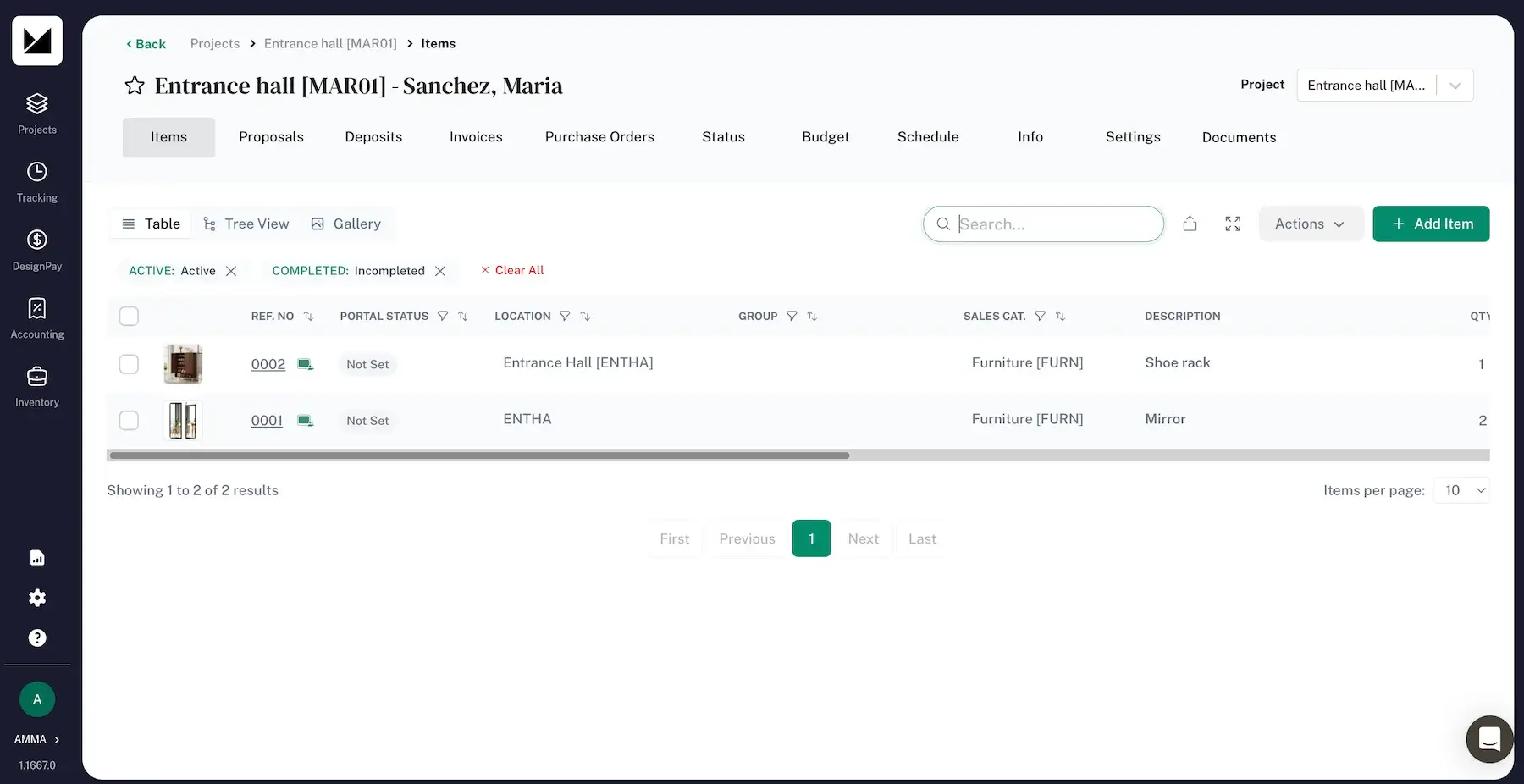
When it comes to accounting, I truly believe this app has it all covered for both freelancers and studios.
I really like that everything is well-connected. For example, you have the option to add invoices right from your project board, and they are immediately saved under client invoices in the accounting section.
My top accounting features are:
- Organized accounts — the accounting menu clearly separates the features belonging to receivable and payable accounts and lists several general ledger (G/L) categories.
- Practical procurement accounting — the app allows you to add specs to purchase orders, invoices, and proposals and automatically links them to the dedicated account features, thus eliminating double entries.
- Design pay — a practical feature that works as a payment processor allowing clients to make payments directly through a link. I couldn’t test it on a trial, but it’s still worth mentioning.
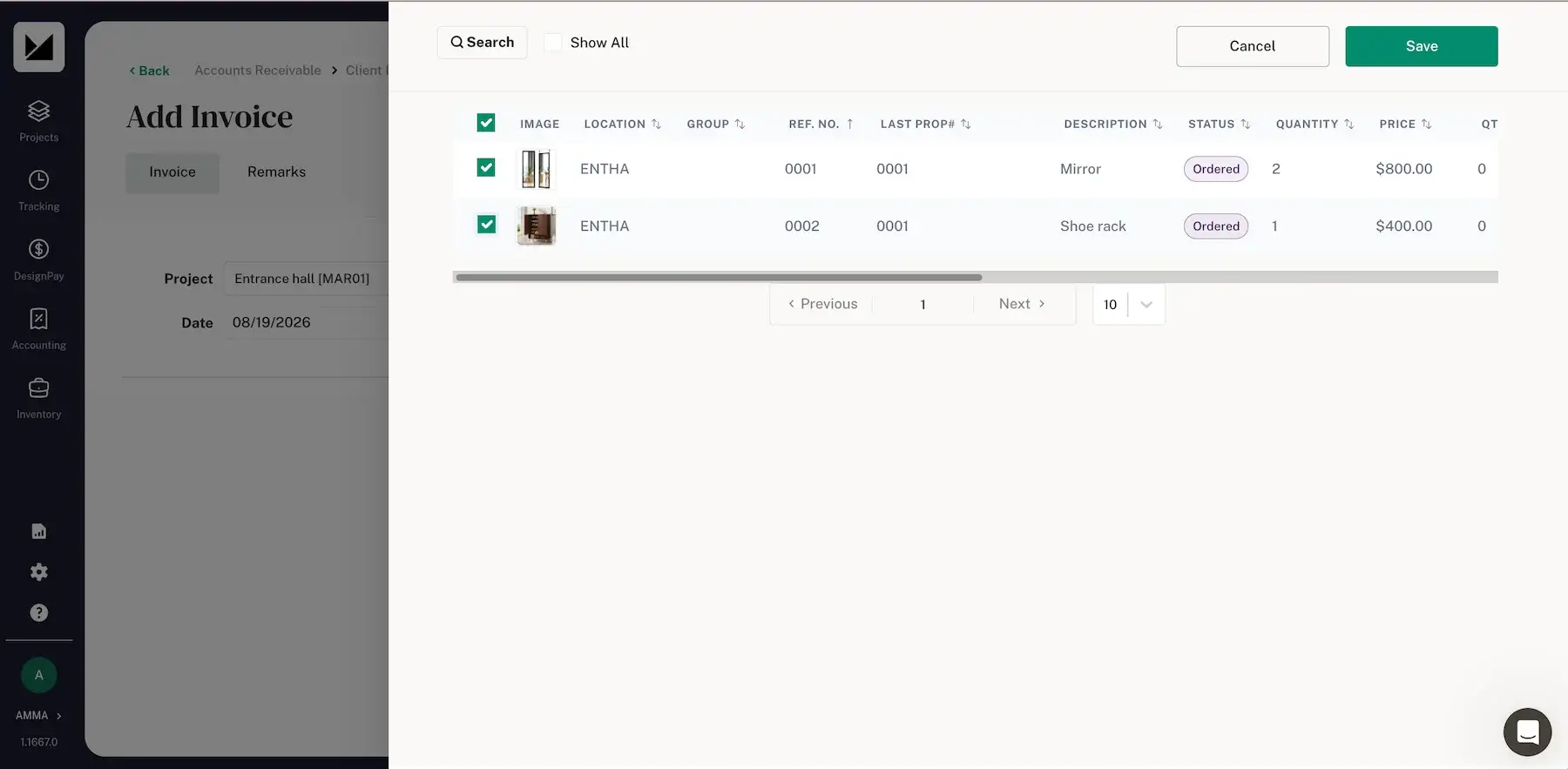
Although you’ll be able to manage proposals, track client deposits, handle purchase orders with vendors, and more, it’s my impression that this tool puts more focus on project management than on design itself.
The main downside is that it lacks visualization tools, such as the ability to showcase projects in 3D or create mood boards. I would expect this (and more) from the most expensive tool on the list.
Also, the app does have a steep learning curve — though that’s understandable considering its rich accounting features.
On the positive side, you can make full use of the app’s help page, which has plenty of articles, videos, and webinars to help you with onboarding. I also recommend using the in-built chat bot, DM Operator, for any questions and requests.
What’s new in Design Manager?
Design Manager recently added new types of reports such as Freight analysis and project cash allocation. There have been improvements in dashboards and client invoices, and the app now has a calendar timeline that shows up to 10 project phases on a Gantt chart.
Available for: web, iOS
| Plan | Price |
|---|---|
| ❎(no name) | $79/user/month* |
*Teams with 10+ members should contact the Sales team for the price.
#3 Programa — best for procurement and order management
Programa is interior design software built for both the architecture and design industry. It helps solo designers, studios, and large teams manage workflows and centralize collaboration with clients and suppliers.
Why choose Programa?
If you need a tool focused on design work but with a simple procurement and ordering process, Programa is worth considering.
| Pros | Cons |
|---|---|
| – Studio management – Libraries – Simple procurement and ordering – Pulse | – No 3D renders and floorplanning – No mobile app |
The moment I started my 7-day free trial, I opted for the option to create my first schedule. This was a bit confusing at first, as I expected to create a project, but I soon realized that Schedules are the app’s central point for finances and procurement.
After the initial confusion, using Programa was quite straightforward and intuitive — something designers will appreciate. The clear sidebar lists the most important features, making navigation easy.
My impression is that the platform offers a good balance between simplicity and functionality. Here’s what I liked the most:
- Studio management — this feature lets you organize your tasks and display them by status, track time by date, team, or project, and create a to-do list for you and your team members.
- Libraries — you can store supplier, client, and contractor details in the address book, keep the most frequently used products in the Product Library as well as collect images for your future projects in the Image library.
- Presentations — the app lets you make presentations of products from your schedule and share them on the client dashboard to enhance collaboration and approval process.
Programa also boasts some other useful features. For example, like most other apps on this list, Programa allows you to install the Web Clipper and automatically pull in products, saving you a lot of time.
You can also record meetings and connect them to a particular project. And, thanks to the feature Pulse, you’ll get information on the most important action items and real-time updates on your projects so you’re always informed.
Moreover, the app lets you create and organize Pinboards (Programa’s mood boards) that you can add to your clients’ presentations so that they can take a look and give feedback.
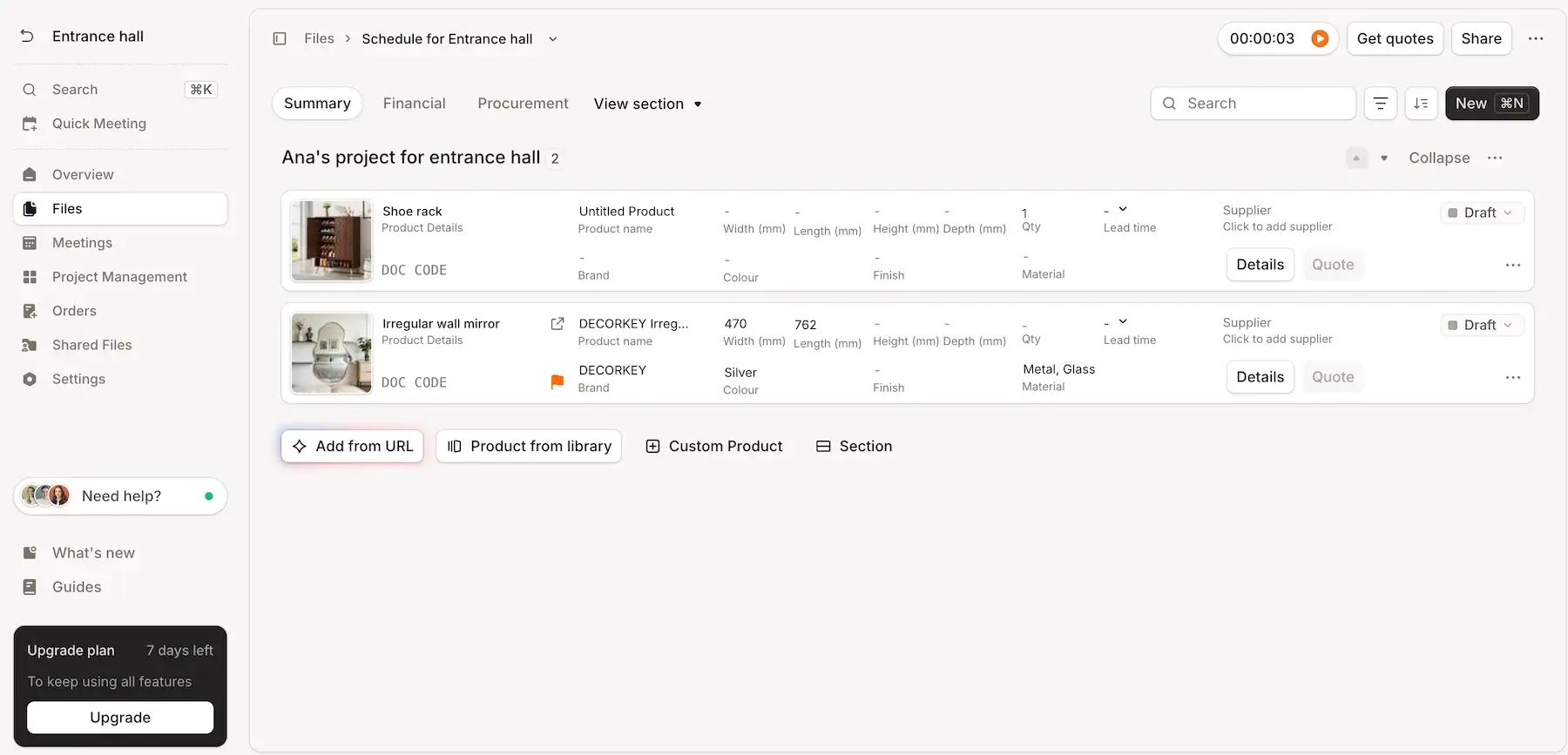
That said, I was pleasantly surprised with how simple and efficient ordering and procurement is in Programa. Here’s what helps the process:
- Procurement tab — add the procurement tab in your project schedule from the dropdown menu to enable the management process.
- Product details tab — set different statuses for your product, see the tracking URL, track procurement and payment dates, and more.
- Create order — once you get client approval, you can create an order directly from the project schedule.
- Financials — manage finances, add markups, and set trade discounts and profits right from the project schedule, which helps you streamline your payment processes.
You should know that, once you upgrade your plan, you’ll be able to create branded invoices for your clients and manage payments directly in the app.
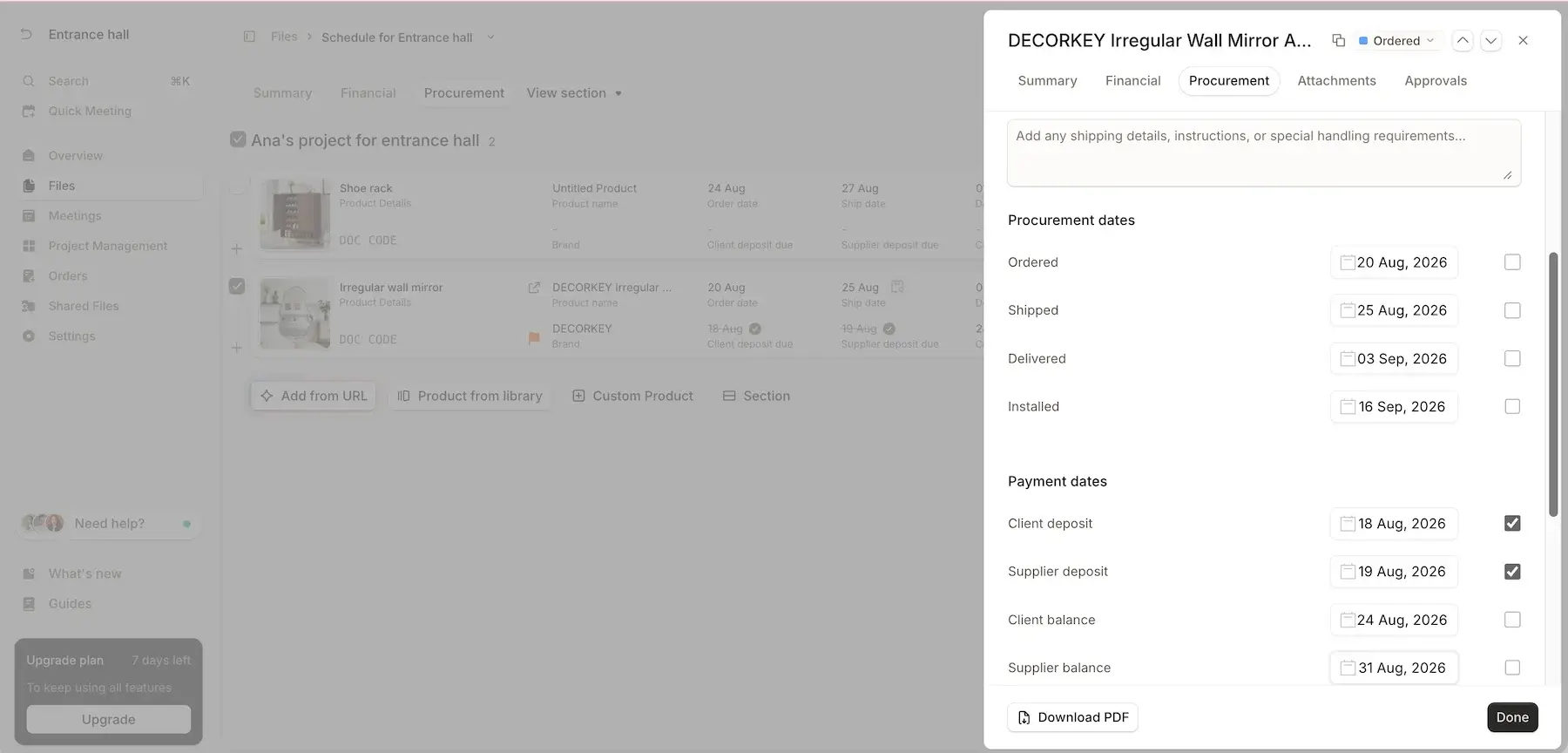
Overall, Programa helps you stay organized and streamline your studio’s processes with ease.
Still, what this app lacks are features like 3D renders and floorplanning. You need to rely on some other software to create such visuals and import them into Programa.
Also, Programa doesn’t offer a dedicated mobile app, which makes it tricky to do some work while on the go.
What’s new in Programa?
Programa has improved its meeting notes. You can now share them to the client portal or send a link to the notes to your team members. Also, once your products are approved, you can add them to invoices directly from Pulse.
Available for: web
| Plan | Price |
|---|---|
| Pro | $71/seat/month* (+$31/month per additional seat) |
*billed annually

#4 DesignFiles — best for creating moodboards and floor plans
DesignFiles is an all-in-one platform focused on project management for interior designers and e-designers. It helps them organize daily work, manage projects and teams, communicate with clients, and handle approvals, orders, and invoices.
Why choose DesignFiles?
The app offers many features, combining a moodboard editor, 3D floor planner, AI render, and an extensive product library to deliver great design solutions.
| Pros | Cons |
|---|---|
| – Intuitive – Client questionnaires – Moodboard editor – 3D floor planner | – No mobile app – Laggy |
DesignFiles is a comprehensive app with clearly organized sections for projects, products, tasks, financials, and more. I found it easy-to-use and more visually appealing than some of its competitors — there’s no sidebar and spreadsheet-style boards typical for PM platforms.
This is what stood out for me:
- Customizable templates — cut hours of work with ready-made templates available for presentations, contracts, task lists, and more.
- Client questionnaires — create different questionnaires, and send them to your clients through the app’s client portal to avoid back-and-forth emails and misunderstandings.
- In-built project calendar — use the calendar to assign tasks, identify overbooked days, flag overdue tasks, and share the calendar with your team for transparent collaboration.
- Project discussion panel — send direct messages to both your clients and team members for smoother and faster communication.
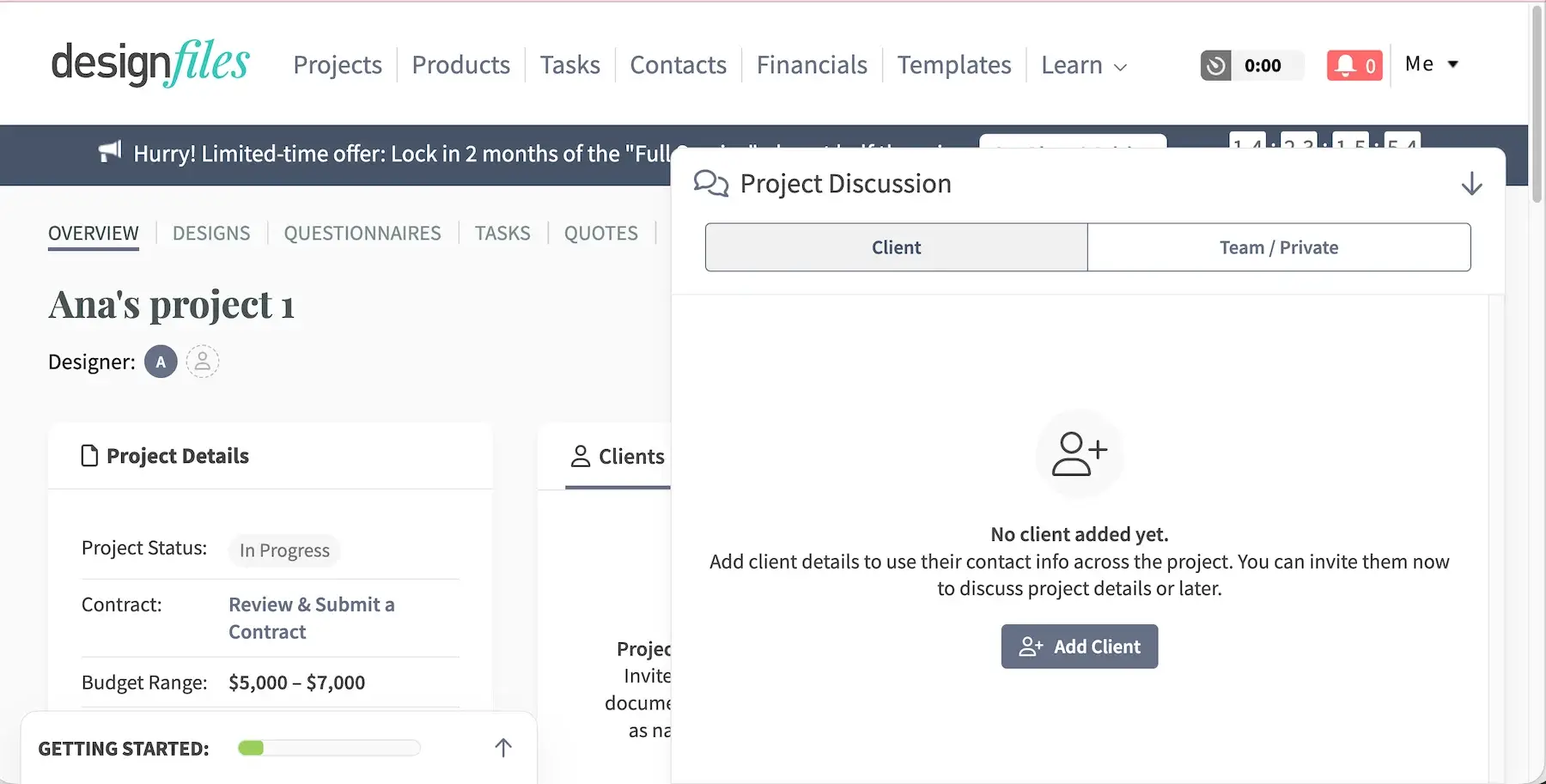
DesignFiles app includes basic task and project management features, which makes work organization more efficient. For instance, you can tag teammates, set due dates, assign priorities, and add comments within tasks.
In terms of design, here are the functionalities that stood out to me:
- Library and product clipper — the app has an outstanding product and paint library with more than 2 million products and paint collections as well as a product clipper you can use to add more products, enabling you to source faster.
- Drag-and-drop moodboard — you can clean up product images and remove backgrounds, add shadows and layering, crop, flip, resize, etc., to generate polished and visually appealing designs.
- 3D Floor plan — easily add, delete, resize, and adjust walls, ceilings, windows, and doors, add furniture, build custom kitchens, and use AI renders to refine your designs and create more realistic images (with every paid account, you get 48 free AI credits as a one-time allocation).
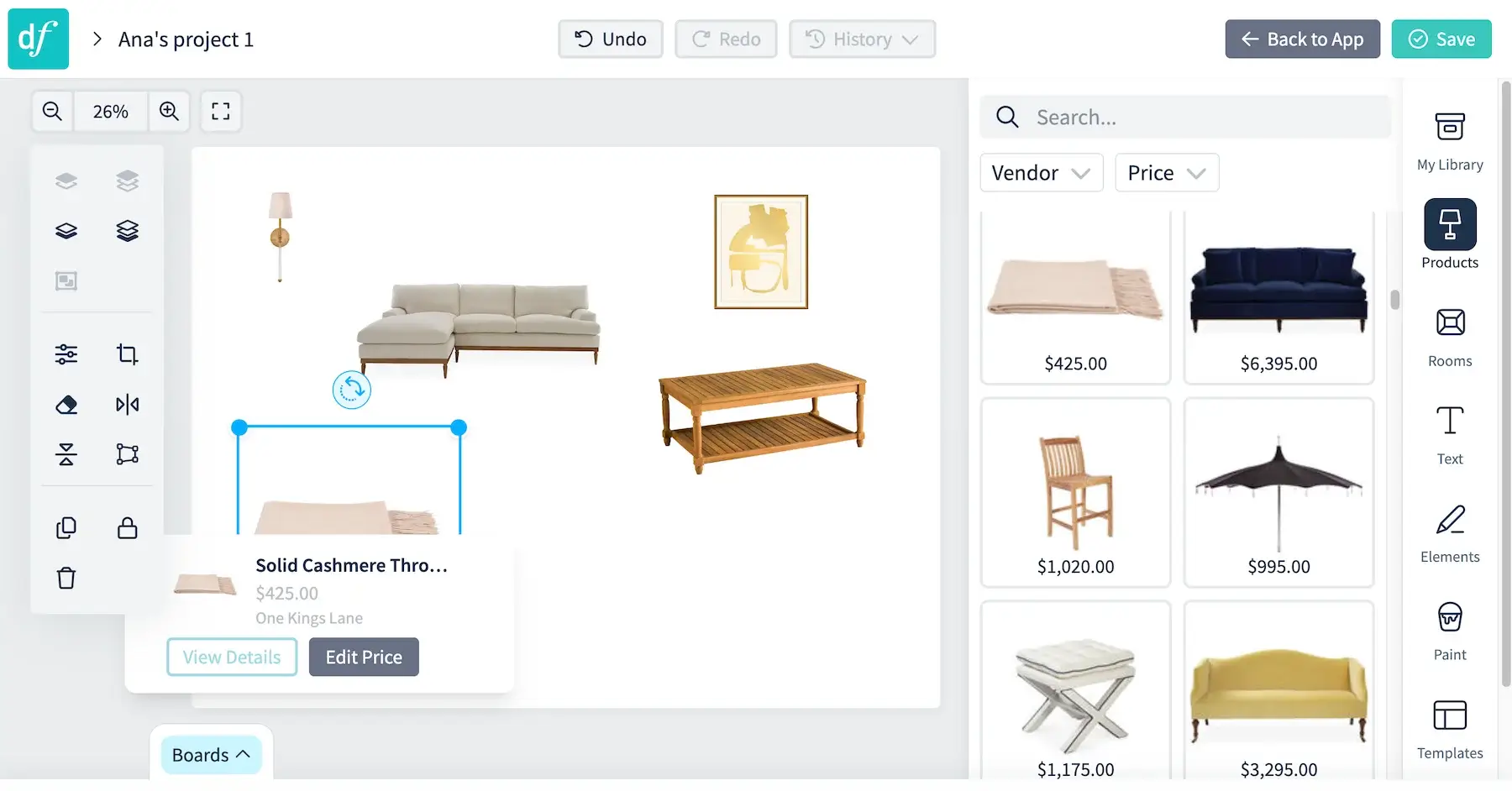
I encountered a few small glitches that made certain features temporarily unresponsive, but nothing that would completely disrupt the workflow. For example, I noticed the platform can be a bit slow, especially when searching for items and vendors, or working with the 3D modeling feature.
Another thing I noticed is that, while the 3D rendering option was helpful, it felt somewhat basic compared to more advanced design software. To get more sophisticated modeling capabilities, you’ll need to put AI to use and pay extra for more credits.
Finally, the tool lacks a mobile app, which is a big downside if you need to make adjustments when you’re on-site with a client or otherwise unable to use a computer.
What’s new in DesignFiles?
Recently, the app enabled autosave for contracts along with the option to manage what clients can see from the preview mode. In addition, you can now replace images on your mood boards using a simple drag-and-drop system, as the app finally dropped the old “save and upload” way.
Available for: web
| Plan | Price |
|---|---|
| e-Design | $55/user/month* (+$30/month per additional user) |
| Full Service | $75/user/month* (+$30/month per additional user) |
| Enterprise | POA |
*billed monthly
💡 PLAKY PRO TIP
For more useful project management tools, check out our other comparison articles:
#5 Floorplanner — best for quick 2D and 3D floor plans
Floorplanner is a free browser-based interior design platform used by individuals, real-estate agents, students, teachers, as well as design pros to create accurate floor plans in a simple way.
Why choose Floorplanner?
The tool is versatile — it lets you visualize your ideas and make the most of your space with the help of 2D and 3D floor plan visuals, photorealistic 3D renderings, moodboards, and more.
| Pros | Cons |
|---|---|
| – Clear dashboard – Collaborate link – Simple toggle between 2D and 3D views – 3D tours | – Export projects via email only – No option to add custom products to the library |
Once I created and verified my account, the app offered me the options to pick the room wizard, upload a 2D floorplan, or start with an empty plan.
I think the room wizard is quite practical for beginners, because it works like a shortcut. You can select a room shape, adjust dimensions, and select a style that best matches your room type (living room, bedroom, gym, home office, etc.). Once you’ve made your choices, you can start your project and move on with the design process.
Floorplanner won’t overwhelm you with fancy features, but it does offer some solid options worth mentioning:
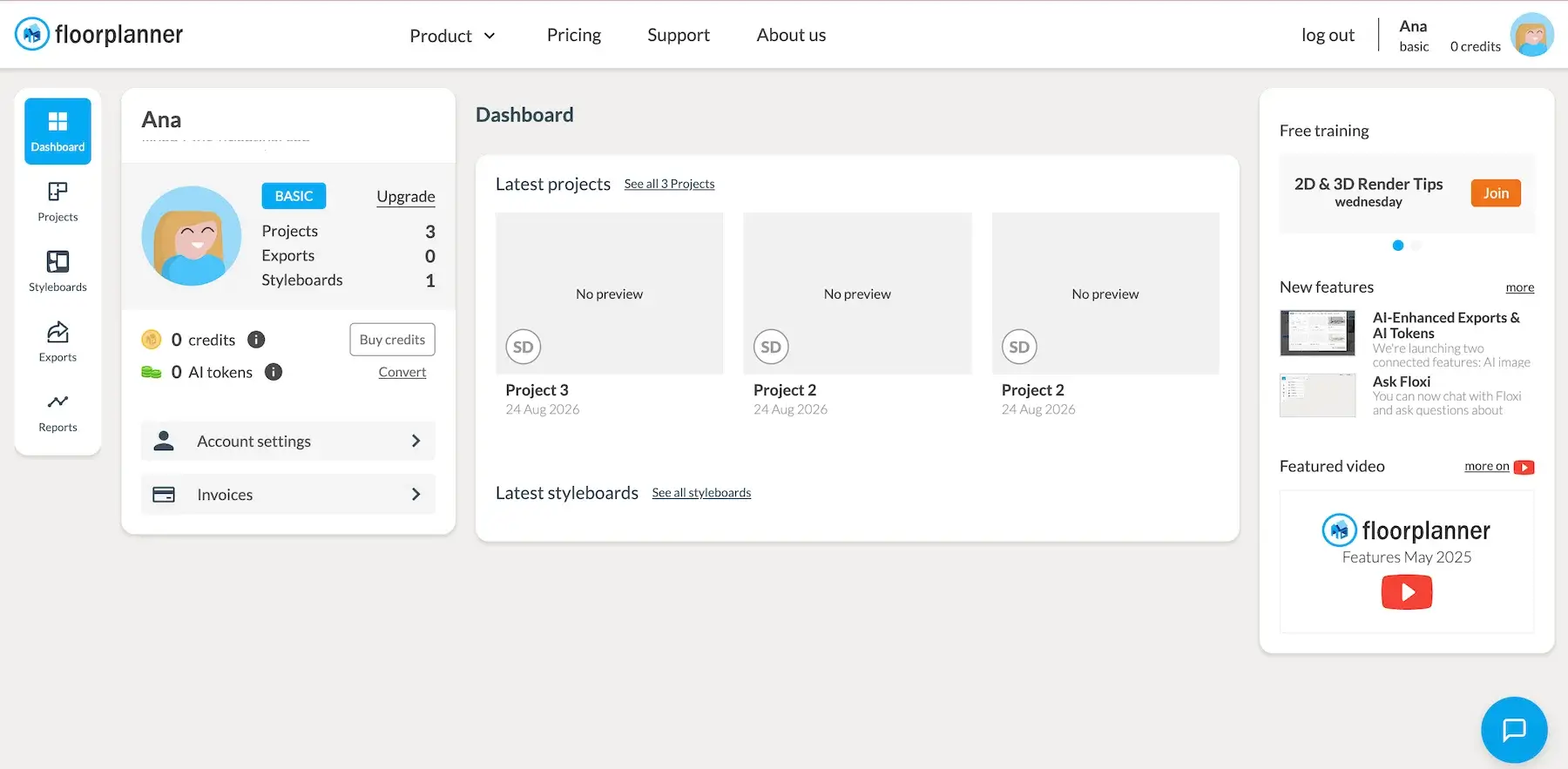
- Clear dashboard — set your account, see the number of projects, list all invoices sent to you by the app provider, get info on new features, etc.
- Collaborate link — send temporary links to your collaborators to give them access to your projects and get feedback easily.
- Reports — get a timeline of your app usage and a stats page of your credit transactions.
The credits are the one thing that makes Floorplanner different from the rest of the apps on my list.
The app is free if you only need its basic features. However, you have to buy credits to upgrade your projects and get access to advanced features — better quality exports, more than 3 floors per project, etc.
You can buy Floorplanner credits without a subscription or plan, which is a cost-effective way to upgrade projects without committing to a paid plan. Another good thing about credits is that they never expire.
I picked Floorplanner as the best tool for quick 2D and 3D floor plans because of the following features:
- Styleboards — use these moodboards to gather products that go well together and show clients your visual direction.
- Magic layout — auto-fill the room with products you used on any previous styleboard to save more time for design polishing.
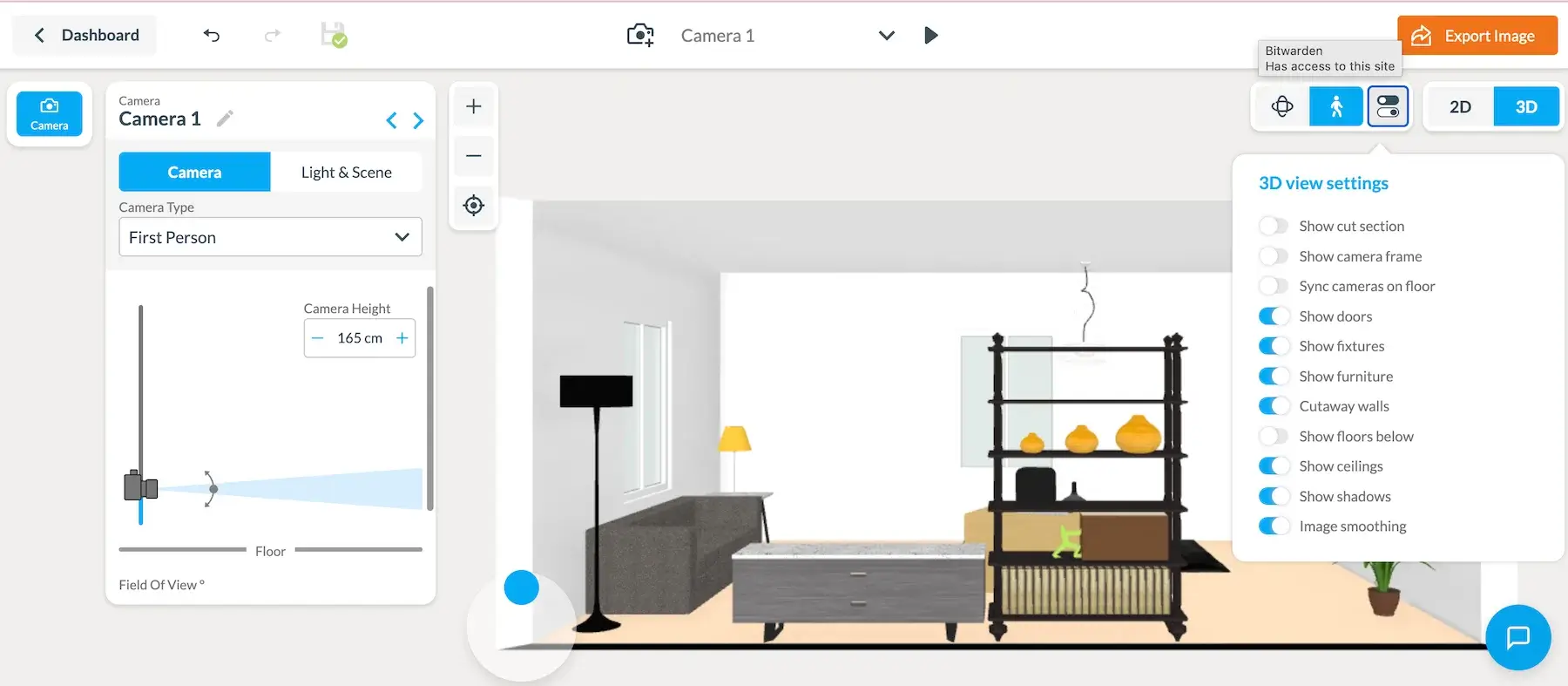
- Instant switch from 2D to 3D floor plan view — toggle between 2D and 3D buttons to change views.
- Camera type — set up this 3D floor plan feature to see your interior design from different perspectives (dollhouse and first person).
- Product library — the app has over 260 thousand 3D objects in its library, giving you full access to more than 30 chosen brands.
As for the cons, I’d like to have had the ability to import custom furniture and objects on the free plan, instead of being limited to the app’s library (this option is only available with Enterprise tier).
Also, Floorplanner has limited project management functionalities, so you’d have to rely heavily on external tools for task management, accounting, and similar. On top of that, you can only send exports via email, which makes collaboration slower and impacts version control.
What’s new in Floorplanner?
The last update was in September 2025 when they launched AI image enhancement and AI tokens (for granular pricing). You can use AI to make changes to 3D interiors or floorplans.
Available for: web, iOS (Floorscanner app)
| Plan | Price | |
|---|---|---|
| Individuals | Basic | $0 |
| Plus | $5/month* | |
| Pro | $29/month* | |
| Teams | Team | $59/month (up to 10 users) |
| Business | $179/month (up to 100 users) | |
| Enterprise | $599/month (up to 1000 users, price per project) |
*billed monthly (excluding VAT)
#6 Planify — best for client collaboration
Planify is a relatively new platform built for interior designers, architects, and small studios to help them manage projects and collaborate with clients.
Why choose Planify?
Planify is a client-focused platform that centralizes all client communication and collaboration features in a single shared space using simple no-login technology.
| Pros | Cons |
|---|---|
| – Client portal with magic link – AI Fetch – Financial proposals – FF&E schedule | – No AI renders nor floor plans – No option to assign tasks to team members |
Planify offers a 21-day free trial with full access to features, which is way more than I expected.
The app is quite simple to navigate and there are no excessive buttons all over the place. The sidebar takes you to your tasks, projects, vendors list, and canvas (moodboard), and displays 2 boxes with tasks in progress and backlog.
I like how Planify organizes project boards. Having all project-related pieces right there on the board (from onboarding and scheduling to budget tracking and contact list) makes project management much more efficient.
Having said that, here’s what helps you streamline your projects in Planify:
- Proposal builder — once your client approves an item in the portal, Planify automatically creates a proposal for you and reduces manual work.
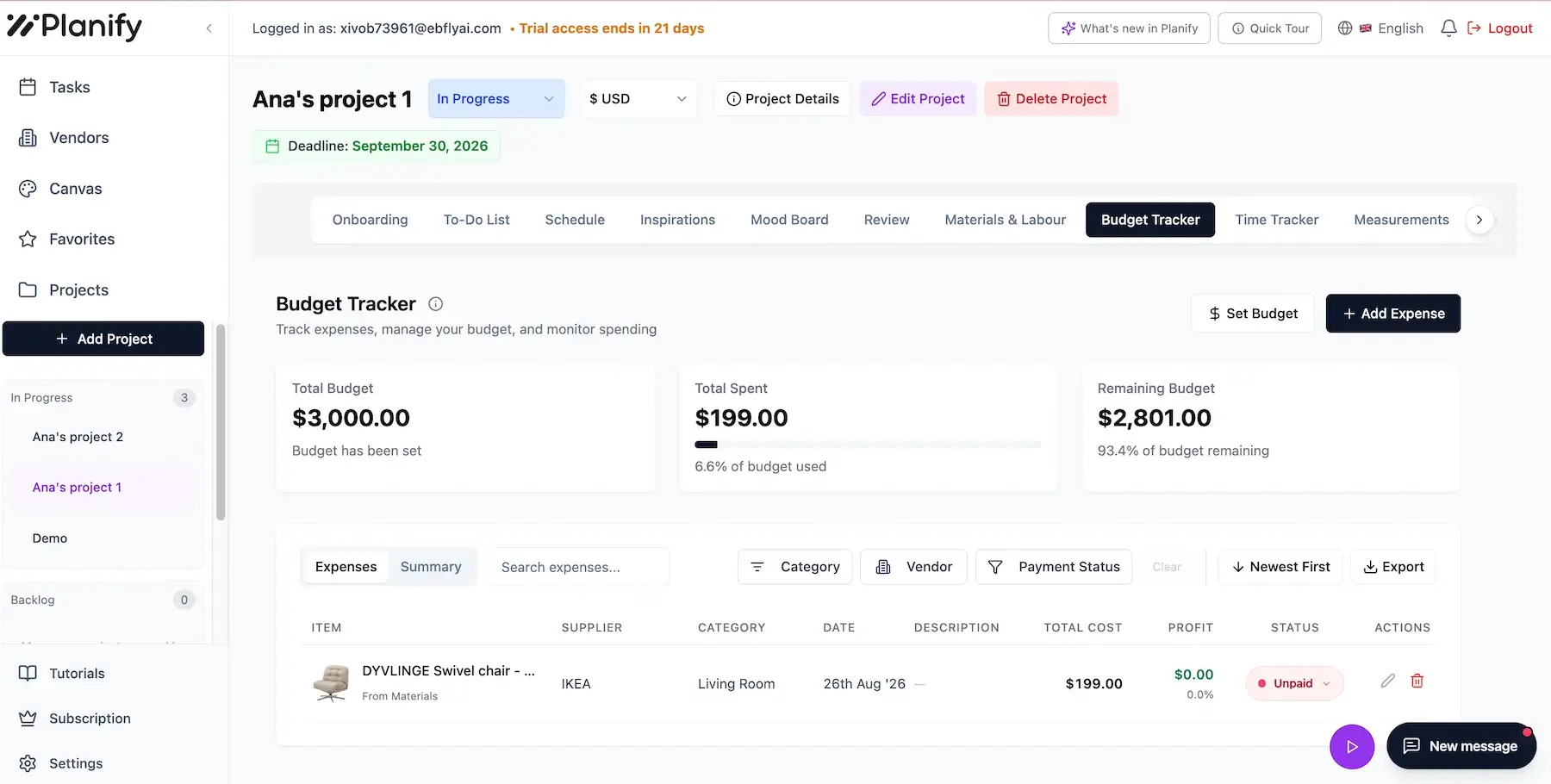
- Budget tracker — all approved items are sent to the tracker in real-time, which helps you monitor expenses and payment status and keep everything in sync.
- Canvas — this is currently the only design-dedicated space where you can add items and drag them to the moodboard to build layouts you can share with a client.
- AI Fetcher — paste any product URL, and the app’s AI bot will fetch all product data, making it super easy to add a new moodboard item.
I particularly liked the way Planify solves client cooperation with features such as:
- Onboarding questionnaire — you can send branded questionnaires to your clients to get answers on their preferences, budget, and more.
- Client portal — your clients can access a shared portal to leave comments on creations and proposals, give sign-offs, and see project schedules, inspirations, and relevant documents.
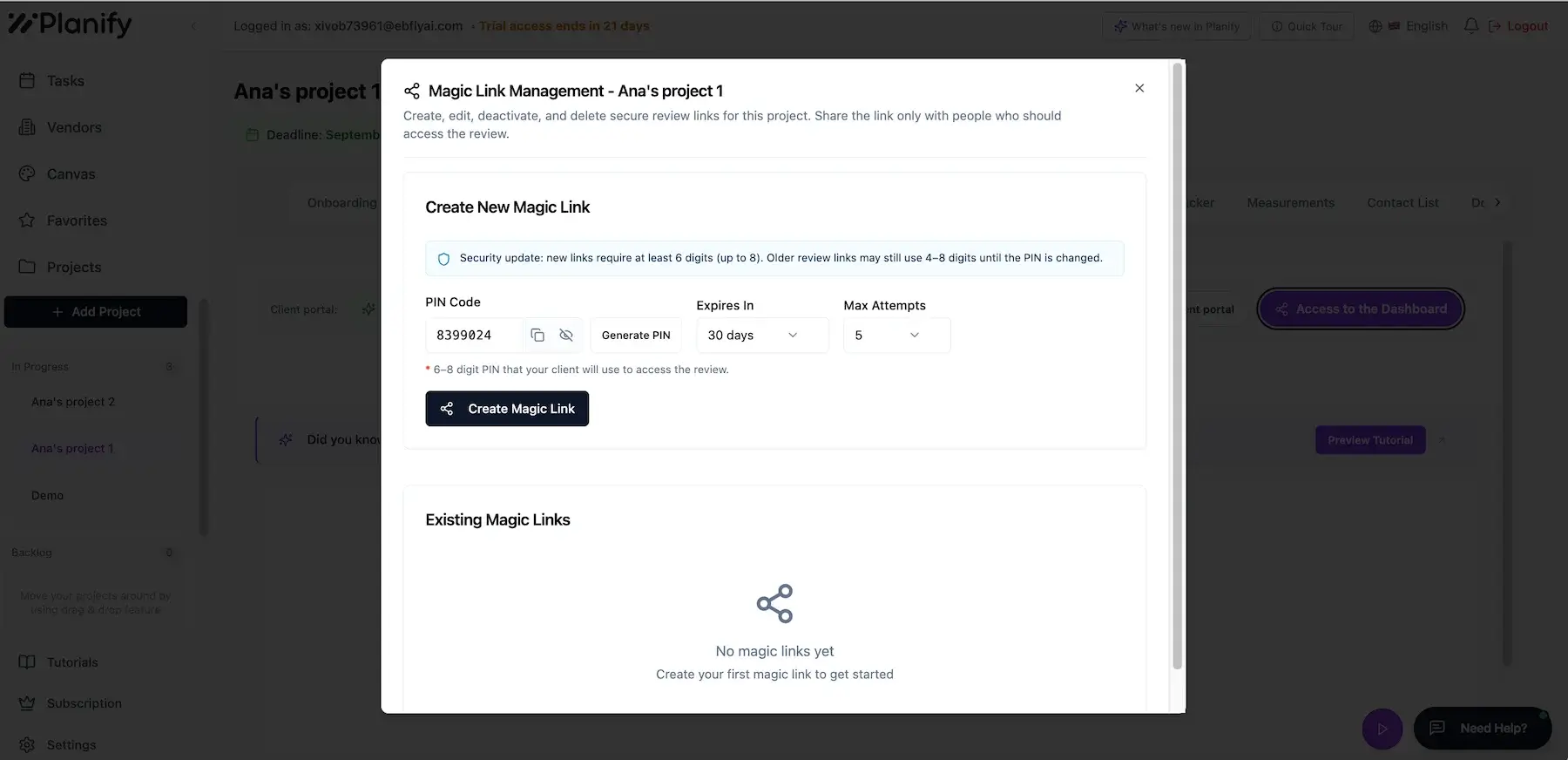
- Magic link — you can send a magic link to your clients to give them access to the client portal (which means they don’t need an account on Planify to collaborate with you).
- Inspirations — you and your clients can add images and links related to the project in this shared space and leave comments on them.
- Image annotations — you and your clients can pin a comment to any spot on the shared images to give precise feedback and keep collaboration smooth.
Planify has no advanced administrative features for invoicing, accounting, or procurement. Plus, it doesn’t currently offer AI renders and floor planning.
Also, I couldn’t find a way to assign studio members to my project board. The only workaround is to share your account log-in details with your design team so that they could see tasks and upload visuals, which really slows down the process.
Still, I’d say the app has great potential — both for designer use and for improvement.
What’s new in Planify?
Planify added an in-app AI support assistant to help you with every day work. Also, you can now link vendors to products when you add or edit a product.
Available for: web
| Plan | Price |
|---|---|
| ❎(no name) | $24.49/month* (unlimited studio team members) |
*billed annually
What to look for in interior design PM software?
Here are some essential features to consider when choosing the best interior design project management software:
- FF&E management — clip products fast, build detailed specification sheets for timely purchase, secure approvals, and coordinate delivery.
- Client portal — in this shared space clients can see presentations, mood boards, proposals, etc., and give approvals.
- Procurement & order tracking — manage and track products from initial quotation to installation and keep projects on schedule.
- Budget tracking — ensure transparency so clients know how their money is spent.
- Task management — assign team members to tasks, set deadlines, track status, etc.
- Invoicing — keep cash flow in order, track expenses, and help designers get paid for their work.
- Moodboards — provide clear visuals that help clients check if their vision matches the designer’s.
- Product library — enable designers to quickly clip products, pull in specs, and keep brand consistency.
- Time tracking — keep track of billable and non-billable hours spent on projects and help designers make better time estimations in future.
- Floor planning — let clients see how their space is used and whether every part of it is well-planned.
- 3D rendering — give your clients a realistic view of their space and eliminate guesswork.
How to choose the right tool for your studio
The choice of best software for interior designers working in a studio depends on:
- Your team’s size — If you have a small team, look for a simple, easy-to-adopt tool with integrations for the administrative part of the work. If you have a large design studio, consider more comprehensive tools offering enterprise-level features.
- Features you need — Make sure the app works for you and your team. Studios generally need features for project and task management, visualization options, accounting and procurement features, as well as client portal for easier collaboration.
- Flexibility — If you often work remotely or on the go, you may need a mobile app. So, be sure to check for that.
- Ease of use — If your design team isn’t tech-savvy and doesn’t want to waste time on figuring out how things work, choose a simpler, more user-friendly platform. Avoid complex ones that will slow down processes.
- Budget — Define your budget, and list the features you really need. Keep in mind that not many interior design apps offer free plans, and there are significant differences in the cost of paid plans. It’s always better to request a demo before making a final decision, or start a free trial period to test the app on your own.

FAQ
Still having trouble picking your best interior design PM tool? Here are some questions and answers that could help you make a choice:
What is the best project management software for interior designers?
The best project management software for interior designers is the one that strikes the perfect balance between the features you or your studio needs for work and the price they can afford to pay.
Do interior designers do project management?
Yes. Namely, they need a tool that enables them to manage tasks and delegate them to their team members, track deadlines and statuses, store files, and communicate about task-related issues.
What software do most interior designers use?
While some designers prefer using professional tools like AutoCAD, SketchUp, or Canva and combine them with a project management tool like Plaky, others prefer having most of what they need in one place and use Programa, DesignManager, DesignFiles, etc. It all depends on the designer’s individual needs.
Is there free project management software for interior designers?
Yes, you can try Plaky and manage your interior design projects seamlessly.
How much does interior design project management software cost?
There’s a wide range of prices, from $0/user/month to $79/user/month. Check out our summary table for more info.
Can you use Monday or Asana for interior design projects?
Yes, you can use both tools to manage projects and tasks for your interior design projects.
However, you should know that, unlike Plaky, their free plans cater up to 2 users only.
If you opt for their paid plans, make sure they are actually cost-effective. You probably won’t need advanced features like portfolios, critical path, or map view for simple management of your interior design projects, so why waste money on them?
Take control of your interior design workflows with Plaky by CAKE.com
Each app on my list offers a range of different features that might be a good fit for some. However, if you’re looking for project and task management features that can help you streamline your interior design workflows, I honestly recommend Plaky.
Apart from helping you take control of any interior design project, Plaky is a perfect choice if you:
- Own a small studio.
- Just started your business and don’t need an overly complex or expensive management system.
- Simply need additional help with managing your current business.
With Plaky, you get another team member that guarantees:
- Top-notch security — Thanks to CAKE.com’s high security standards, Plaky keeps your data safe and lets you control who has access to your what using defined user roles and permissions.
- 24/7 support — Our customer service works around the clock (24/7/365) and is 100% human. You can always contact them for help and advice, no matter the plan you’ve subscribed for.