Unlike some comparisons that are more “apples and oranges” in nature — like project management and operations management — change management and project management often work in tandem.
The changes implemented through change management can affect how projects get done. Sometimes, project managers actively participate in implementing these changes.
But where does project management end and change management begin? That is the topic we’re concerned with here.
Change management vs. project management: Overview
The term “change” in project management refers to a new way of work being implemented on a large scale in order to solve a problem or improve operations. It can come in the form of regulatory changes, change in leadership, structural changes, etc.
While people usually dislike change, change in project management is generally a positive prospect. What’s important is how it is implemented and managed.
With this in mind, here are the key differences between change management and project management.
| Project management | Change management | |
|---|---|---|
| Definition | Project management is the structured means of getting the project done on time and on budget, usually by following one of many project management methodologies. | Change management is a structured approach to getting people to support a desired change beneficial to the organization and have them act in accordance with it once the change has been implemented. |
| Success criteria (outcome vs. output) | Project management is largely output-oriented. A successful project is one where the agreed-upon deliverable is completed on time and within budget. | Change management is largely outcome-oriented. A successful change is one where a new state of things is successfully achieved. (For example, if the goal is to move from a traditional to a fully remote working model, emptying the offices with minimal disturbance in the quality of work would be considered a successfully implemented change.) |
| Processes vs. people | Project management focuses on how to execute the project and uses established processes to reach its goals. | Change management focuses on getting people to support and act in accordance with the change, while creating minimal disturbance to the work they do. |
| Methodologies vs. models | Project management relies on structured project management methodologies to guide the execution of the projects. | Change management relies on models that aren’t as structured and robust as PM methodologies. Some models are process-focused, but most models are people-focused, describing not how to implement a change, but how to guide the people to accept and adapt to the change. |
| Leadership and collaboration | Projects are led by project managers. They lead the project team and coordinate the work to finish the project on time and within budget. To do so, they need strong organizational and leadership skills. | Organizational change is led by a change practitioner. They have no say in what is being changed or how. Their role is only to plan and prepare strategies for change, as well as support people affected by this change. |
We should note that change management is not the same as project change control, which deals with the identification and approval (or rejection) of changes to project documentation, baselines, and deliverables.
What are the differences between change management and project management?
In simple terms, the project management side of things implements the changes, while the change management side of things works to get the people on board with the changes and prepare/train them.
However, this simplified explanation can make it seem like project management and change management have very little in common. But in practice, the line separating them can be murkier than it first appears.
To clear up the distinction, let’s look at some of the blurry lines that can cause confusion.
#1 Outcome and output
First, let’s define the success criteria for project management and change management.
A successful project is one where the final deliverable is submitted on time, on budget, and within the agreed-upon technical specifications. In other words, the goal of project management is output-oriented — to create the final deliverable.
Conversely, change management is outcome-oriented. If the desired state of affairs is to go paperless, reaching that outcome will indicate success.
Now, this isn’t a binary thing — success metrics for change management can include the speed of this transition and how adept employees are at using the new system. But, by and large, change management isn’t as focused on time and money as project management is.
#2 People and processes
You’ll often hear that project management deals with processes while change management deals with people. But, the distinction isn’t always so black and white and bears further explanation.
So, let’s say you need to construct a bridge — a textbook example of a project.
You could attempt to do this without formal project management practices, but you’ll likely fail.
Project management is using formal processes — like PM methodologies, Agile frameworks or hybrid project management, and various project management tools — to increase the chances of project success.
The more structured and formalized the project management processes of an organization are, the higher their project management maturity is.
So, when change management is tasked with changing a process — like switching to better project management software — the outcome of this change will affect project management, i.e. how you get things done.
However, to get the change implemented in the first place, you need to get the people on board with it — this is why you’ll hear that “change management deals with people”. If a new process is introduced to supplant an old one, but employees keep doing things the old way, you can consider that change a failure.

#3 Methodologies and models
Project management is a field that has been studied and improved upon for a long time. Testament to this is the sheer volume of project management methodologies that project managers can utilize to manage their projects from start to finish — like Waterfall.
The Waterfall methodology divides the project into 5 stages:
- Requirements
- Design
- Implementation
- Verification
- Maintenance
It also doesn’t allow backtracking to any previous stage, making it ideal for projects where things need to be done right the first time, like construction and manufacturing.
Projects that need more breathing room in terms of requirements — like many software development projects — can instead utilize one of the many Agile frameworks — like Scrum or Kanban — to structure task management and prioritization. These frameworks allow the project team to make iterative decisions and changes and improve the product as they are making it.
Change management, on the other hand, uses completely different models — which aren’t quite robust enough to be called methodologies — to successfully implement and reinforce change in an organization.
PMI’s Managing Change in Organizations: A Practice Guide highlights the following 5 steps to implementing change within a project, program, or portfolio:
- Formulate change
- Plan change
- Implement change
- Manage transition
- Sustain change
While this model provides a framework for how to structure change within an organization, most change practitioners also use the ADKAR Model, which describes the 5 stages people go to when adapting to change:
- Awareness
- Desire
- Knowledge
- Ability
- Reinforcement
So, whenever you implement changes, you have to think about the people it will affect just as much as how you will plan and implement said changes.
#4 Leadership and collaboration
The project manager leads the project, and works together with the project team to create the final deliverable. They need to have mastery over a range of project management skills, both soft and hard, to effectively coordinate project work and finish the project on time and on budget.
We’re not trying to say that project managers don’t collaborate with their team members, just that — as project leaders — they have the authority that substantiates this “captain and crew” analogy.
Now, you’d think that the person at the helm of change initiatives would be a change manager, but this isn’t necessarily the case.
Firstly, the term “change manager” rarely gets used. You’ll run into it sometimes, but most of the authoritative literature on this subject uses the term change practitioner instead.
Secondly, the role of a change practitioner can’t be summed up with such a simple “captain and crew” analogy. The term practitioner already has a less executive ring to it than manager, which is more indicative of the role.
According to Prosci, the core roles in change management are:
- Change practitioner
- Project manager
- Sponsors
- People managers
Change practitioners prepare plans and strategies for change and support people affected by this change. While we could still call this a leadership role, they lack the authority over impacted employees that project managers have.
Instead, change practitioners have to rely on communication to successfully implement changes.
Support your change and project management with Plaky by CAKE.com
Whether you’re leading projects or guiding people through a period of change, Plaky is here to help you along the way.
With your entire organization in one place, organizing tasks, coordinating projects, and communicating ideas in Plaky becomes a walk in the park.
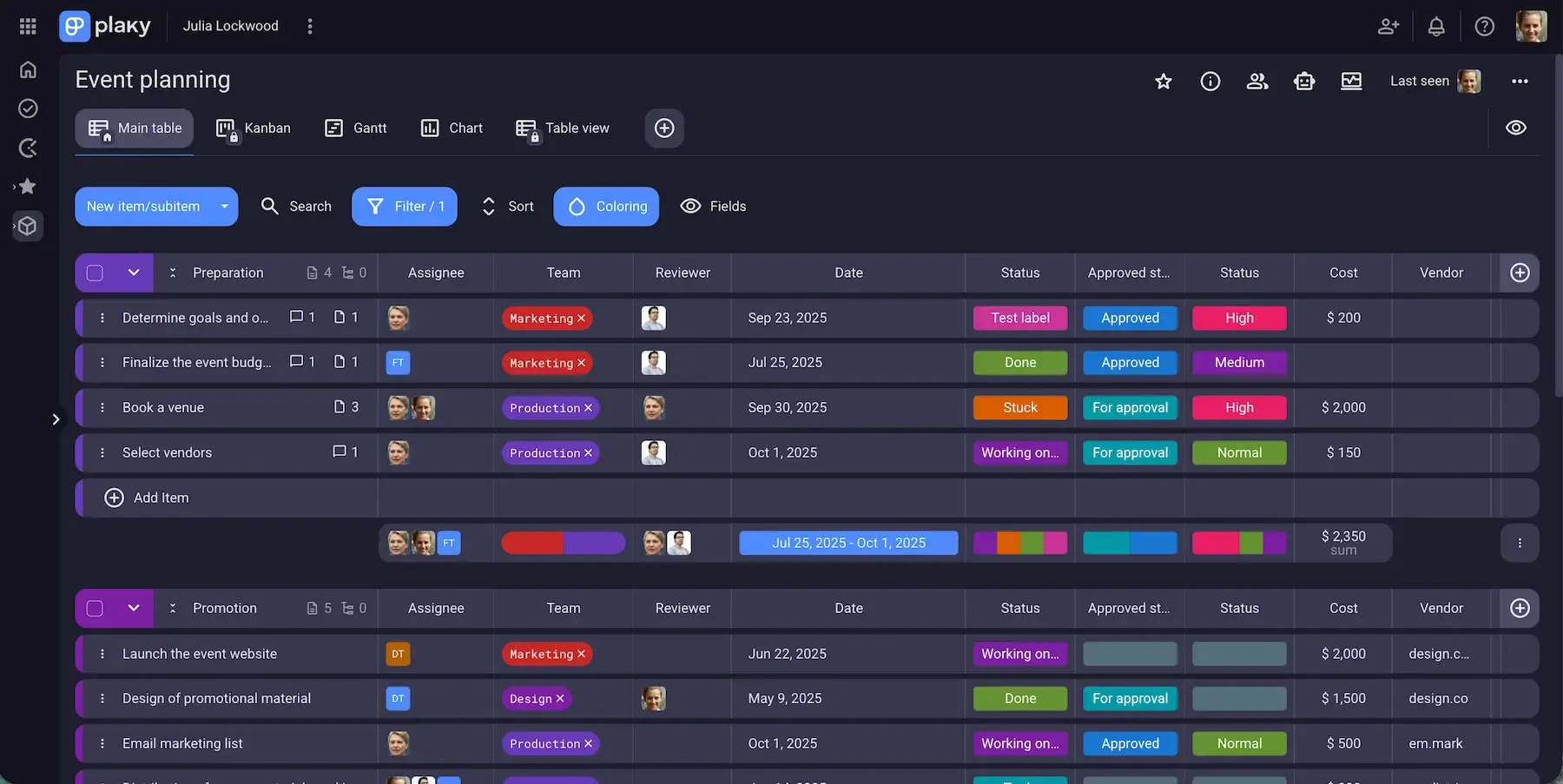
Use Plaky’s Table view to organize Items and Subitems, and get a general overview of your tasks in an interactive, spreadsheet-like format. To see your data presented from different angles, simply change the Board view to Kanban, Gantt, or Chart and get a clean, top-down overview of your entire project.
To collaborate with your team, leave Comments, assign tasks, and get notified of changes instantly or Integrate Plaky with Pumble and receive curated notifications straight into your DMs.
Enjoy Plaky’s 99,99% uptime and 24/7 human customer support for free, or choose one of its affordable paid plans for more advanced features and security options.
Get started with Plaky by CAKE.com
How we reviewed this post: Our writers & editors monitor the posts and update them when new information becomes available, to keep them fresh and relevant.