Deciding on a price for your product or service can be tricky. Set it too high, and people disappear, or too low, and you leave money on the table.
The good news? You don’t have to guess! And we’ve done the legwork for you — 7 proven pricing strategies, each explained with clear examples.
By the end of this article, you’ll have a better idea of how to set prices with confidence and adjust when needed.
Let’s dive right in!

- Relying on a pricing strategy helps you stay competitive and aligned with customer needs.
- Cost-plus, competitive, and value-based pricing are the most widely used models.
- Choosing the right strategy for you largely depends on your industry, business goals, and type of product/service.
- Pricing should be revisited periodically, testing the changes before any radical moves.
- Simple and transparent pricing drives conversion.
In this article:
What are pricing strategies?
Pricing strategies are different approaches a business uses to decide how much to charge for their product or service. In doing so, a business must consider their strategic marketing plan and the ongoing market situation.
In practice, a pricing strategy helps you answer questions like:
- What is the real value we’re offering?
- How does our price compare to competitors?
- Should we launch high or low?
- When should we adjust?
Instead of guessing or going with what “feels right,” it’s crucial to pick a strategy that ensures you can grow revenue and stay competitive while communicating your product’s value effectively.
Top 7 pricing strategies (with examples)
There’s a broad range of pricing tactics to consider. While each one has its strengths, some tend to show up more often in the real world because they’re practical and easy to implement across different industries.
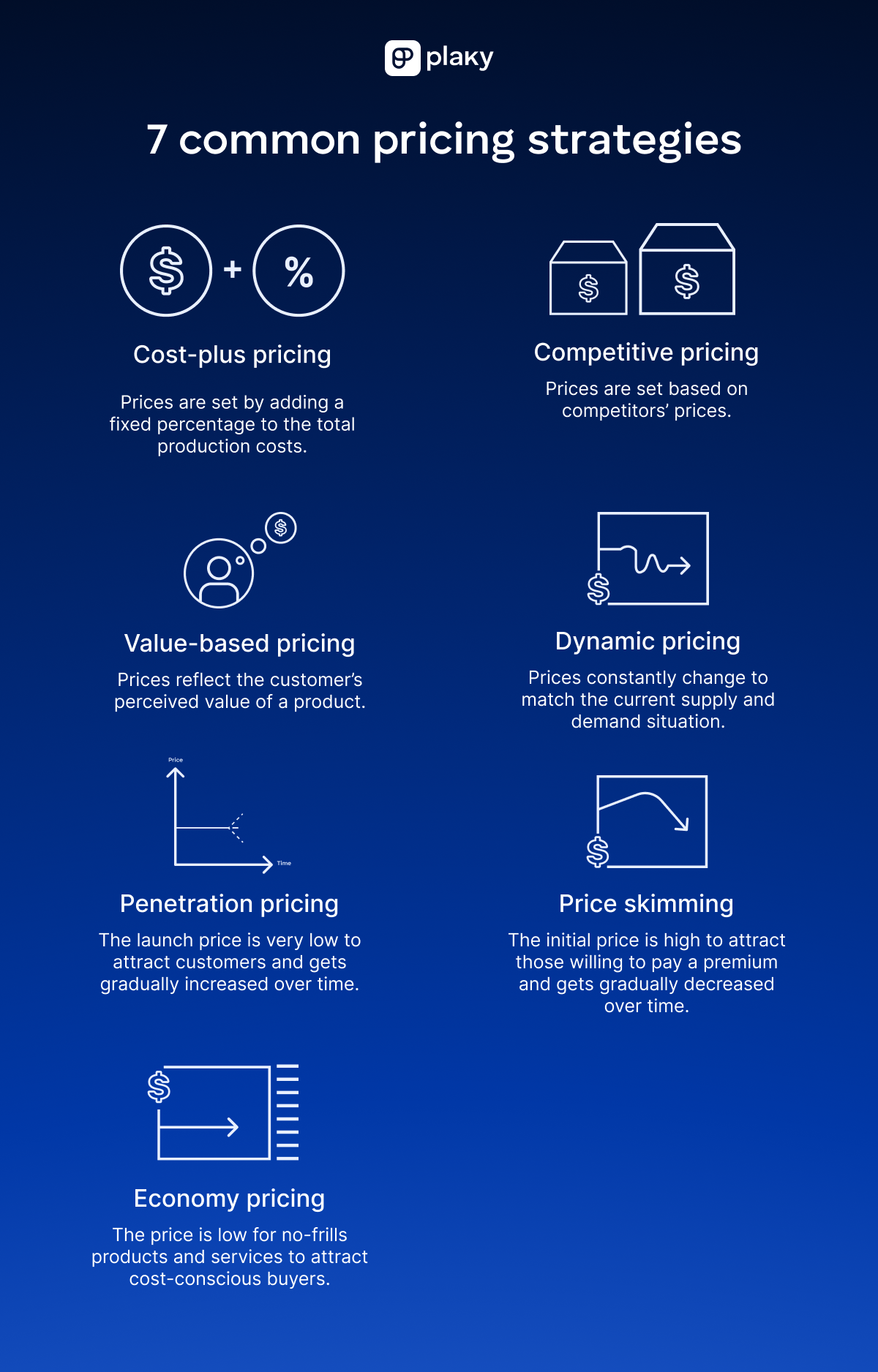
So, here are 7 common pricing strategies you should know about.
#1 Cost-plus pricing
Cost-plus pricing (also known as cost-based or markup pricing) is one of the most widely used strategies, as it follows this simple formula:
Total Cost + Markup = Price
Your total cost is the sum of direct costs (materials, manufacturing, labor) and indirect costs (rent, utilities, admin).
And markup is a percentage to the total production cost (e.g. 20–50%) to ensure profit. It usually depends on industry standards, retailer requirements, or forecast demand.
So, cost-plus thrives in industries where production costs are clear and products aren’t easily differentiated. Some examples include:
- Manufacturing,
- Retail & distribution,
- Construction & contracting,
- Food & hospitality, and so on.
To illustrate, let’s say a contractor is building a custom deck. The expected costs are $6,000 (materials + labor + equipment rental + overhead allocation), and there’s a 20% markup. This means:
- $6,000 + ($6,000 x 0.20) = $6,000 + $1,200 = $7,200
While this strategy is very “rational” on the surface, there’s a psychological angle too. It creates a feeling of fairness and transparency, which can reduce internal pushback and help justify prices to stakeholders, clients, or procurement teams.
Overall, cost-plus is easy to use and understand, but it also has some limitations — namely:
- Neglecting customer value — You set prices based on your cost, not what customers are willing to pay.
- Risky in industries with volatile costs — If ingredients or supply prices swing, the constant price adjustments become tedious and confuse customers.
To conclude, cost-plus is safest in stable industries but can be a liability in competitive, customer-driven markets.
#2 Competitive pricing
Competitive pricing means you determine your price primarily based on what your competitors are charging, hence the alternative terms competition- or market-based pricing.
You can look at it like this:
Competitor Price ± Adjustment = Price
The adjustment depends on your strategic intent, i.e.:
- Price below competitors — to attract cost-sensitive customers,
- Price at parity — to fit into market expectations, or
- Price above competitors — to signal higher quality or value.
Let’s use an example — a new mobile phone accessory brand launching wireless headphones. This brand researches their top 3 competitors and learns their prices for the same kind of product are as follows:
- Competitor A: $28.99,
- Competitor B: $31.50, and
- Competitor C: $29.99.
The average competitor price, then, is the sum of those prices divided by 3, which equals $30.16. Depending on what the business in our example wants to accomplish, they could choose:
- Lower-than-market positioning: $27.99,
- Parity pricing: $29.99, or
- Premium positioning: $32.00.
This kind of approach is most effective in markets where customers can compare prices instantly and where switching costs are low — for instance:
- Retail & e-commerce,
- Customer electronics,
- Airline & travel,
- Telecom, etc.
Although it looks purely market-driven, competitive pricing also has psychological power — anchoring to the “expected” price and increasing customers’ trust.
All in all, this approach is simple to apply since competitors’ prices are typically shared publicly, so you can easily analyze them.
On the other hand, competitive pricing also has cons such as:
- Ignoring customer value — You base prices on competitors, not the value you deliver.
- Potentially causing price wars — If everyone keeps undercutting, no one wins.
- Hindering differentiation — It’s harder to communicate why your product is better.
#3 Value-based pricing
Value-based pricing is a strategy where you set the price based on the customer’s perceived value of the product.
There’s no universal formula to follow here. Instead, this approach requires a deep understanding of how your target audience benefits from your solution and how it translates into economic or emotional value.
In fact, value-based pricing shines where innovation and high-impact outcomes matter, e.g.:
- SaaS and digital products,
- Professional services & consulting,
- Luxury goods,
- Art & collectibles etc.
I can provide an example — a SaaS tool for financial management with 3 tiers:
- Basic, $15/user/month — It offers basic features, mostly used by freelancers. The tool saves them about 5 hours/month. If their hourly rate is $25, that’s $125 saved, so paying $15 feels like a bargain.
- Team, $49/user/month — It has everything in Basic plus team collaboration features. The app saves cca 12–15 hours/person/month thanks to the shared boards and communication tools. At $30/hour, that’s at least $360 saved, so the price of $49 fits the perceived value.
- Enterprise, $79/user/month — It has everything in Team plus automations and enhanced security, both crucial for large companies. With the tool saving 30 hours/person/month, at $50/user/month, that’s $1,500 saved. Charging $79 reflects that higher value.
This strategy appeals to both financial outcomes (ROI) and emotional outcomes (confidence, convenience, prestige).
As for the drawbacks of value-based pricing, you should consider:
- Time-intensive research — It takes time to organize interviews, surveys, and detailed customer discovery and then use the insights.
- Quantifying value — It can be difficult to quantify the value since some products deliver intangible or long-term outcomes.
- Potential price inconsistency — Perceptions of value may change over time, and different customers perceive value differently. This makes standardization tricky.
#4 Dynamic pricing
Dynamic pricing is used when prices continuously change based on real-time supply, demand, market conditions, or similar segments.
In other words, there’s no single fixed price — you adjust it automatically or manually to fill capacity or react to market shifts. That’s why this strategy is also known as demand-based or surge pricing.
There’s no single formula to rely on. Instead, you take these elements into account:
- Demand levels — High demand means higher prices, while low demand drives discounts or promotions.
- Supply & availability — Limited stock/seats raise prices, whereas surplus inventory triggers markdowns.
- Timing & seasonality — Prices can fluctuate depending on the time of day, day of week, holidays, or season changes.
- External conditions — Certain events, economic factors, or even weather can increase or decrease demand for a product/service.
Dynamic pricing can maximize revenue and optimize inventory/capacity. That’s why it’s commonly used in industries such as:
- Airlines & hotels,
- Ride-sharing,
- Event ticketing (e.g., entertainment, sports)
- Logistics & delivery, and so on.
We can use a simple ride-sharing scenario as an example. It’s rush hour, so the demand spikes, and only 60% of drivers are online. If the base fare is $10, the demand multiplier could be 2.0x due to the high demand and low driver availability. The final price is:
- $10 x 2.0 = $20
Later in the evening, the demand drops and supply increases, so the demand multiplier is now 0.8x. Therefore, the final price is:
- $10 x 0.8 = $8
The psychological factors at play are urgency (“buy now before it gets worse”) and fairness perception (people tend to accept higher prices if they understand demand is high).
That said, the cons of dynamic pricing are:
- Customer frustration — Sudden spikes can feel unfair or exploitative.
- Maintenance complexity — Surge pricing requires data, automation, and constant monitoring, so it’s challenging to execute properly.
#5 Penetration pricing
Penetration pricing means setting a very low launch price to quickly attract customers. Once the product gains traction, the price is gradually increased to a sustainable or profitable level.
You can think of penetration pricing like this:
Market Average Price − Significant Discount % = Price
The discount is often 20–70%, depending on how aggressively you want to enter the market.
Now, an example: imagine a company is selling an email marketing tool. Their main competitor offers a similar product at $29/month, and the said company sets the launch price of $9/month (70% down).
Also, let’s say the company has the goal of gaining 5,000 users quickly, meaning a total monthly revenue of $45,000. After reaching that, the company sustainably increases the price to $19/month.
Admittedly, there can be a drop in the number of users after the price increase. But, even if our example company had a 16% churn rate (4,200 retained users), the monthly revenue would be $78,800.
If you’re wondering why this works — customers like the “too good to pass up” deal effect. And, once they get used to the product/service in question, they don’t want to lose it even if the price rises later.
To sum up, penetration pricing yields benefits such as boosting brand awareness and accelerating market growth. So, it’s popular among new businesses or established companies launching a new product.
In terms of downsides, this strategy can lead to:
- Risk of devaluing the brand — If the initial price is too low, it may signal “cheap” instead of “new.”
- Overly low margins in early stages — This is very risky for companies with tight budgets or high production costs.
#6 Price skimming
Price skimming means launching a product at a very high price to attract early adopters willing to pay a premium. Over time, the price is gradually lowered to attract broader, more price-sensitive customers.
There’s no universal formula, but you do need to think about these key inputs:
- Market research on early adopters,
- Competitor pricing gaps,
- The product’s uniqueness, and
- Timing for phased price reductions.
Price skimming can be highly profitable for innovative products, especially early in the lifecycle. Moreover, this strategy rests on psychological triggers related to status, novelty, and exclusivity, which attract certain buyers.
Given all that, we can often see price skimming in industries such as:
- Tech hardware & gadgets,
- Consumer electronics,
- Luxury products & fashion,
- Pharmaceuticals & medical devices, etc.
A typical example would be a smartphone launch. In the earliest launch phase, the high price of $1,099 and 100,000 units sold generate a revenue of $109.9 million.
Then, in the second phase, the price is $899 with 250,000 units sold, which means a revenue of $224.7 million.
Finally, late adopters join the bandwagon when the price is lowered to $699, and the company sells another 400,000 units, resulting in revenue worth $279.6 million.
So, the total revenue across the full lifecycle would be $614.2 million.
However, despite its profitability, price skimming can backfire if executed poorly or used in the wrong market conditions. Potential disadvantages include:
- Alienating price-sensitive buyers early on — Many will wait months to buy or never buy at all.
- Risk of low initial sales volume — Fewer people can afford the launch price.
- Inviting competitors — Rivals can release lower-priced alternatives, causing you to lose customers.
- Possibility of backlash — Customers may feel cheated if early high prices drop too quickly.
#7 Economy pricing
Economy pricing is a strategy where a business keeps costs extremely low and offers products with minimal frills. The goal is to achieve high sales volumes, maintaining profit even with thin margins.
Here’s the base formula:
Production Cost + Minimal Markup = Price
Companies often aim for margins as low as 5–10%. This immediately attracts shoppers who prioritize affordability. Plus, the more units are produced, the lower per-unit cost becomes.
Therefore, economy pricing works best in industries where products are standardized and competition is high — for instance:
- Retail (store brands, generics),
- Food & beverage,
- Pharmaceutical generics,
- Ultra-low-cost carriers, etc.
We can use a generic cereal brand as an example. Supposing the production cost per box is $0.80, and packing and distribution require $0.20, the total cost is $1.00. With a 10% markup, the final price is $1.10 per box.
Compared to a premium competitor selling cereal for, let’s say, $4.50, the economy brand wins through volume and low overhead.
The psychological angle here relies on consumer mental shortcuts around value. Many assume the low-price option works fine if they don’t need premium features, and by buying cheap, they avoid the risk of “overpaying.”
Still, economy pricing comes with some risks:
- Extremely low margins — Small cost increases (e.g., raw materials, logistics) can wipe out profit.
- Weak brand perception — Customers may associate low price with low quality.
- High reliance on scale — If you have a low sales volume, failure is practically inevitable due to the tiny margin.
Pros & cons of different pricing strategies — overview
Here’s a quick overview of the strengths and weaknesses of all the pricing techniques explained in this article.
| Strategy | Pros | Cons |
|---|---|---|
| Cost-plus pricing | – Easy & quick to use – Feels transparent – Has predictable margins | – Ignores customer value – Risky with volatile production costs |
| Competitive pricing | – Simple & fast to implement – Helps maintain market relevance – Useful when products are similar | – Ignores customer value – Erodes differentiation – Can cause price wars |
| Value-based pricing | – Rewards differentiation – Not tied to costs or competitor limits – Aligns price with customer success | – Requires time-consuming research – Hard to quantify value – Can cause price inconsistency |
| Dynamic pricing | – Responds quickly to market conditions – Maximizes revenue & optimizes capacity | – Can cause customer frustration – Complex to implement & maintain |
| Penetration pricing | – Gains customers quickly – Boosts brand awareness – Effective when switching costs are low | – Has a reduced margin in early stages – Can cheapen brand perception |
| Price skimming | – Maximizes early revenue – Creates a premium brand image – Captures different segments over time | – Brings a risk of low initial sales – Can push away budget-minded buyers – Invites cheaper rivals |
| Economy pricing | – Has high volume potential – Scales well – Strongly appeals to price-sensitive buyers | – Has very thin margins – Relies heavily on scale – Can cause inferior brand perception |
5 actionable pricing tips
Now that you understand the main pricing methods, let’s look at some practical tips you can apply to make your pricing more resilient.
#1 Position your offering properly
Your pricing will only work if customers understand why it’s priced that way. Our contributor Jason Vaught, a content and marketing director, shared his thoughts:

“Before choosing your pricing strategy, you must understand how a consumer perceives your brand. Do they visually understand it as a discount, mid-level, or luxury brand? Pricing yourself as a luxury brand when consumers see you as mid-level will result in friction, and you will likely lose the sale.”
As only a well-positioned product makes your pricing feel natural, be prepared to research your customers’ needs and purchase motivators.
#2 Feel free to combine multiple strategies for pricing
You don’t need to be loyal to a single pricing model. Some companies benefit from:
- Using cost-plus as the minimum viable price, then layering value-based pricing on top to capture the perceived value,
- Starting with a low penetration price, then shifting to value-based pricing once they understand what customers value the most, and
- Applying dynamic elements (e.g., limited-time offers) on top of a stable core strategy, etc.
Hybrid pricing offers flexibility and lets you serve different customer segments more effectively.
#3 Revisit your pricing annually (at least)
As your product evolves, the pricing should too. Here’s what our contributor Will Yang, a startup advisor and fractional head of growth, had to say:

“Use data-driven insights to guide your decisions, and be willing to adjust your strategy as market conditions change. Review the strategy periodically to ensure it remains in line with business objectives and customer expectations.”
In other words, it’s essential to consider new features, increased value, or rising costs. This prevents you from falling behind your product’s growth.
#4 Test before rolling out big changes
Pricing changes are necessary from time to time, but remember that even small differences can drastically impact conversion.
To make sure you’re on the right track, you should:
- A/B test pricing pages, tiers, and add-ons,
- Validate pricing with interviews and surveys, not just intuition, and
- Start with smaller experiments to reduce risk and learn faster.
This way, you turn pricing from a guessing game into a controlled experiment.
#5 Keep your pricing simple and transparent
Simple pricing makes customers feel confident about choosing you.
Another contributor of ours — a marketing agency founder & CEO, Anna Stella — shares valuable advice on this topic:

“The pricing strategy you adopt for your business should give flexibility and be easy for the buyer to understand. Do not overwhelm the buyer with too many price options that could make comparison difficult. Instead, offer 2 or 3 price options with a distinct value position. Ideally, tailor the pricing strategy to suit different customer profiles.”
Choose the best pricing strategy with Plaky
Picking the right pricing model is about blending data, positioning, timing, and experimentation. Remember, the strategies we walked through are tools, not templates.
What’s more, your product management software can be of great help when defining prices if you use it to effectively manage tasks, customers, and teamwork.
One such tool is Plaky. Here’s how our platform makes it easier to analyze all the factors needed for setting your optimal pricing:
- Centralized & flexible data management — Data (customer feedback, sales numbers, competitors research, etc.) should live in one place that you can fully customize. This way, you spot trends faster and ensure pricing is evidence-based.
- Powerful automations — Automations help your team spend less time configuring processes and more time analyzing outcomes. For instance, you can use Plaky to auto-assign tasks for updating pricing pages or billing rules, trigger alerts when certain metrics change, and so on.
- Collaboration features — Pricing affects everyone (product, marketing, sales, finance, CX), so cross-team alignment is crucial. That’s why Plaky offers shared workspaces and in-task comments.
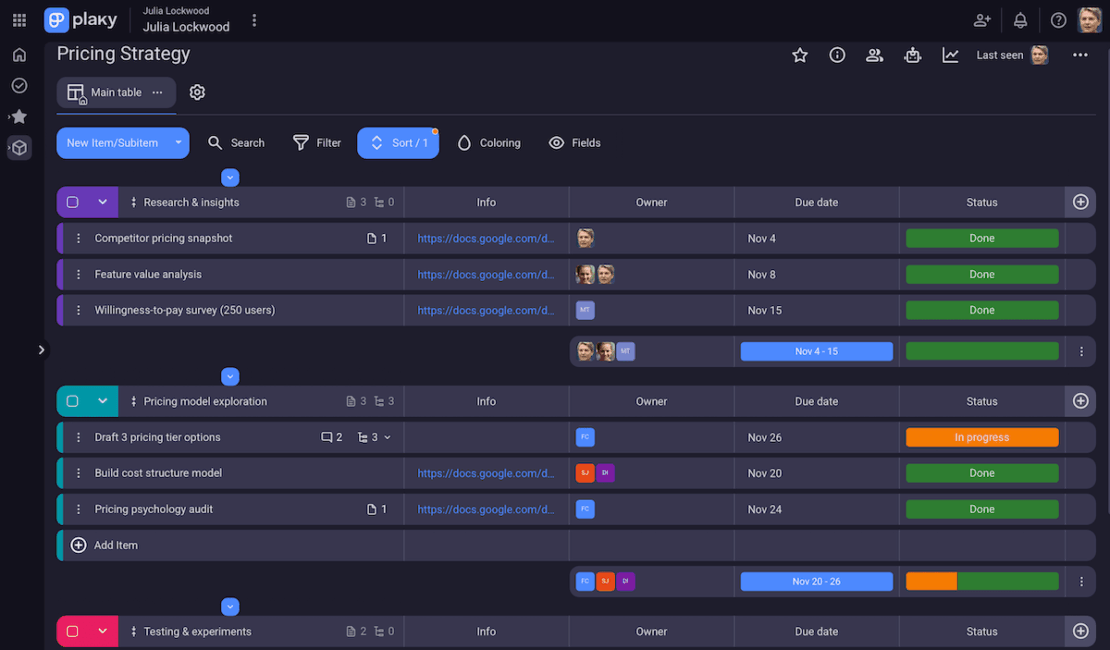
Understand your market, product, and customers better with Plaky!