
With so many projects and tasks, how do you know which ones to prioritize?
One of the many ways project managers effectively prioritize projects is with different prioritization methods. One of them is the RICE framework.
Read on to learn how to implement the RICE score for more effective project management and prioritization.
- The RICE framework is a project prioritization method used to evaluate tasks and decide which ones to prioritize.
- The framework is based on 4 factors: Reach, Impact, Confidence, and Effort.
- It’s particularly beneficial for product management teams to decide product roadmaps and feature releases.
- The main benefits of this prioritization method include data-driven evaluation, better time and resource allocation, and transparency.
- This scoring system uses a simple formula: Reach x Impact x Confidence / Effort = RICE score.
What is the RICE framework?
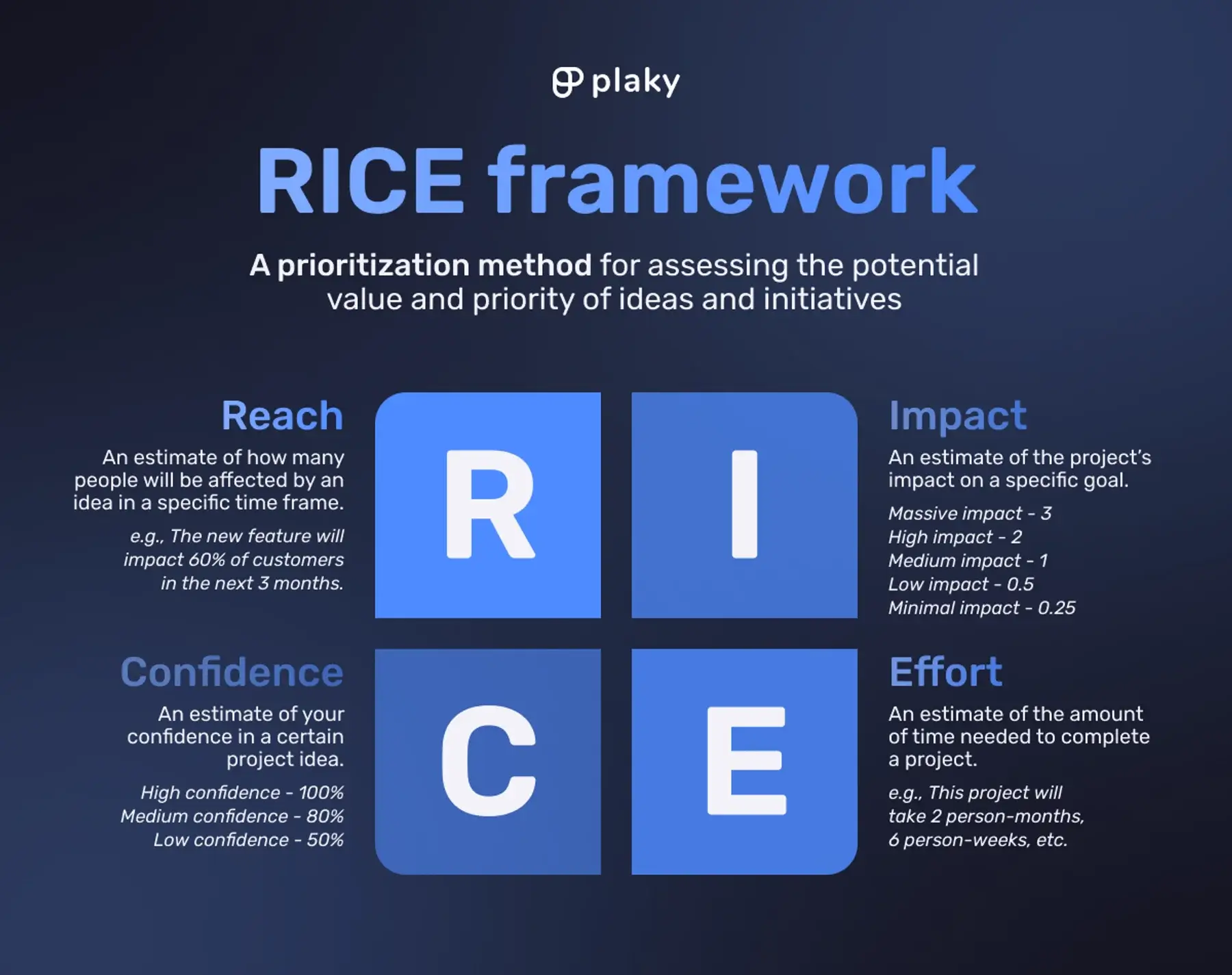
The RICE framework is a prioritization method used to evaluate the potential value and priority of projects. It scores projects across 4 factors:
- Reach
- Impact
- Confidence
- Effort
The RICE methodology is often used as an agile prioritization matrix and helps product managers remove subjectivity from roadmap decisions.
The framework is also known as the RICE prioritization method, framework, process, or model, the RICE scoring model, the RICE scoring system, and the RICE analysis.
💡 Plaky Pro Tip
To learn more about project prioritization and why it’s important, check out our guide:
What is the formula for the RICE scoring model?
The formula for the RICE model is as follows:
Reach x Impact x Confidence / Effort = RICE score
How does the RICE prioritization framework work?
To do the RICE analysis, you must evaluate your ideas or initiatives according to the 4 above-mentioned factors and use the formula to calculate the RICE score.
Once you have the RICE scores for all your ideas, you can analyze them and arrange them according to priority.
Here’s what a RICE analysis can look like in a project management tool like Plaky by CAKE.com:
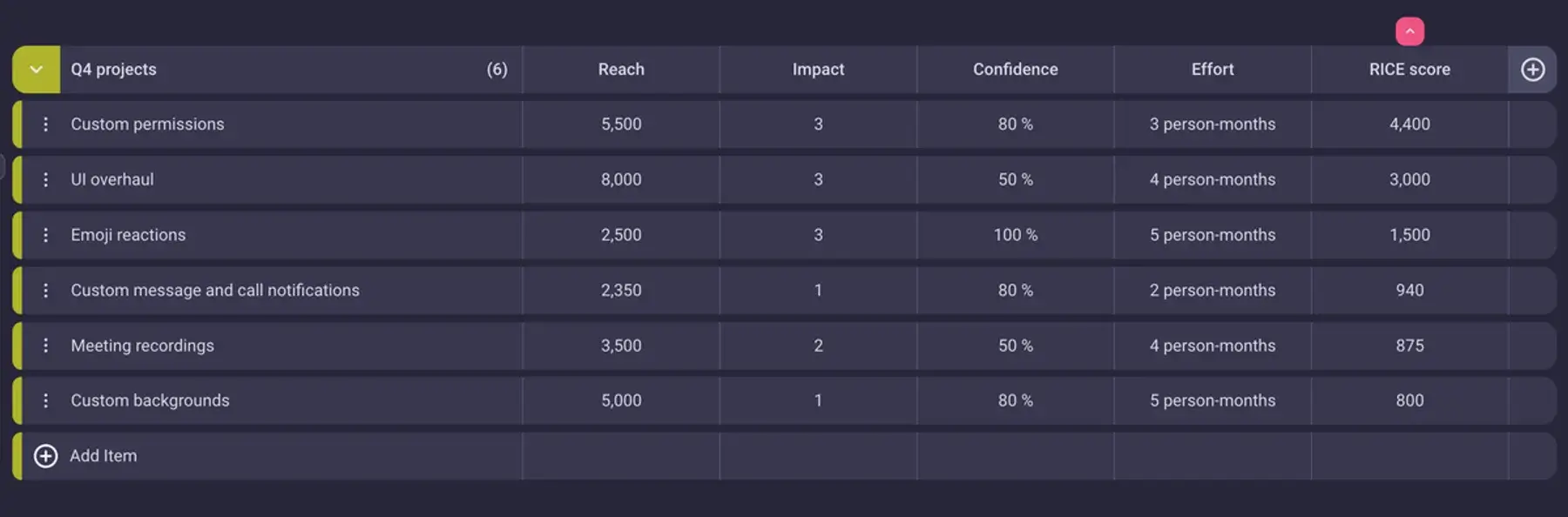
In Plaky, you can create custom Fields for each RICE criteria and input the final score in a separate field. These fields can then be rearranged, sorted by each of these criteria, or summarized in the Summary row.
Use Plaky to prioritize projects
Every organization is free to come up with its own scoring criteria for the following 4 factors.
The following examples will utilize the original scoring system.
Reach
Reach is a quantitative metric used to estimate the number of people an initiative will impact within a specific timeframe, such as calculating the number of active users expected to interact with a new feature.
It helps product managers identify initiatives that have the biggest potential to resolve customer problems, concerns, or needs, and thus, have a wider reach.
To calculate reach, you must first decide the context of the “reach” and the time period you want to consider.
For example, let’s say that Reach refers to the number of people who’ll use a feature in the next month. This new feature will be delivered to 6,000 monthly active users, but you estimate it’ll be used by 40% of them.
Therefore, your Reach score is 40% x 6,000 = 2,400 people.
The higher the Reach, the better the potential impact of your project.
Impact
Impact is a qualitative scoring factor used to measure the expected effect of an initiative on a specific business goal.
For instance, if you’re looking to sell a new product feature to as many customers as possible, the feature that boosts the conversion rate should be prioritized.
Or if your goal as a company is to increase customer delight, then you’ll prioritize features that improve customer satisfaction.
Since it’s difficult to measure, the RICE framework prescribes a simple scoring system for determining an idea’s impact:
- Massive impact — 3
- High impact — 2
- Medium impact — 1
- Low impact — 0.5
- Minimal impact — 0.25
Confidence
Confidence is a score that shows how sure you are about the other 3 factors.
It serves to curb your enthusiasm regarding projects that seem great but their Reach, Impact, or Effort scores aren’t exactly backed by reliable data.
Essentially, if you’ve had to rely on your gut feeling or anecdotal evidence to determine some of the other factors, the Confidence score should reassure you and give you more control over the prioritization process.
In RICE analysis, confidence is expressed as a percentage. Once again, you can rely on a simple scale here to determine how confident you are about a project idea:
- High confidence — 100%
- Medium confidence — 80%
- Low confidence — 50%
Anything below 50% is considered a total shot in the dark.

Effort
Effort is a resource estimation factor used to calculate the time required to complete a project, such as estimating the person-months needed for a team to deliver a new initiative.
To calculate the Effort score, consider the number of people you’d need for the project and how much time they’d take to complete it.
Most often, Effort is expressed as person-months, referring to the work 1 team member can do in a month’s time. However, you can also express it as person-hours, person-weeks, person-Sprints, etc.
For example, an idea might require a 5-person team working full-time to complete it in a month, so the Effort score would be 5 person-months.
On the other hand, you may have 2 people working on the project for 3 months. In that case, the Effort score is 2 x 3 = 6 person-months.
Use whole numbers for Effort estimates. Use 0.5 for tasks requiring half a month or less.
Effort is the only “negative” factor in the framework, so it’s used as a denominator in the RICE equation.
And the higher the Effort score, the worse the project’s RICE score since you’d have to work harder and longer to complete the project.
💡 Plaky Pro Tip
Another prioritization tool that uses similar parameters is the impact effort matrix. Check it out:
An example of a calculated RICE score
Imagine you’re part of a team that has developed and continuously works on a social movie cataloging app.
The app currently has 8,000 active users, and you’re looking to prioritize the product roadmap for Q1 of the upcoming year.
To properly use the RICE framework for your roadmap, you need to:
- Define your project ideas.
- Score your ideas.
- Calculate the RICE scores.
- Analyze the results.
Let’s go through each step in more detail.
💡 Plaky Pro Tip
Not sure how to plan your product roadmap? Use Plaky’s free product roadmap template to keep your team aligned around the same goals and effectively track project performance:
#1: Define the project ideas
Your movie cataloging app has been doing well so far, but users have given you some feedback and are asking for the following features or changes:
- Custom statuses
- Improved search and filter options
- Reports
#2: Score your ideas
After going through the data and getting input from other project stakeholders, here’s how you’ve scored these 3 project ideas:
| Idea | Reach | Impact | Confidence | Effort |
|---|---|---|---|---|
| Custom update statuses | 1,500 active users | 2 | 100% | 5 |
| Improved search and filter options | 3,500 active users | 1 | 80% | 10 |
| Reports | 3,000 active users | 3 | 80% | 20 |
Now, let’s see the RICE scores for each of these ideas.
#3: Calculate the RICE scores
Using the RICE equation mentioned earlier, you can now calculate the RICE scores of your project ideas:
| Idea | Reach | Impact | Confidence | Effort | RICE score |
|---|---|---|---|---|---|
| Custom update statuses | 1,500 active users | 2 | 100% | 5 | 600 |
| Improved search and filter options | 3,500 active users | 1 | 80% | 10 | 280 |
| Reports | 3,000 active users | 3 | 80% | 20 | 360 |
So what do these results say?
#4: Analyze the RICE scores
Once you have your RICE scores, you can clearly see which ideas you might want to prioritize and why.
For instance, the idea you should focus on first is adding custom update statuses, as it requires less effort than the other 2 projects, has a high Impact score, and you’re 100% confident in it.
The other 2 ideas have the same Confidence factor of 80%, but their Effort and Impact scores are drastically different.
Their Reach scores are similar, but the reports project has a much higher Impact score than the search and filters project. Because of that, its RICE score is higher — even though it would require more effort to complete than improving the app’s search and filter options.
Instead of making a separate RICE matrix each time you want to prioritize your project ideas, you can list them all in a project management tool such as Plaky by CAKE.com.
Here’s what this example looks like in Plaky:
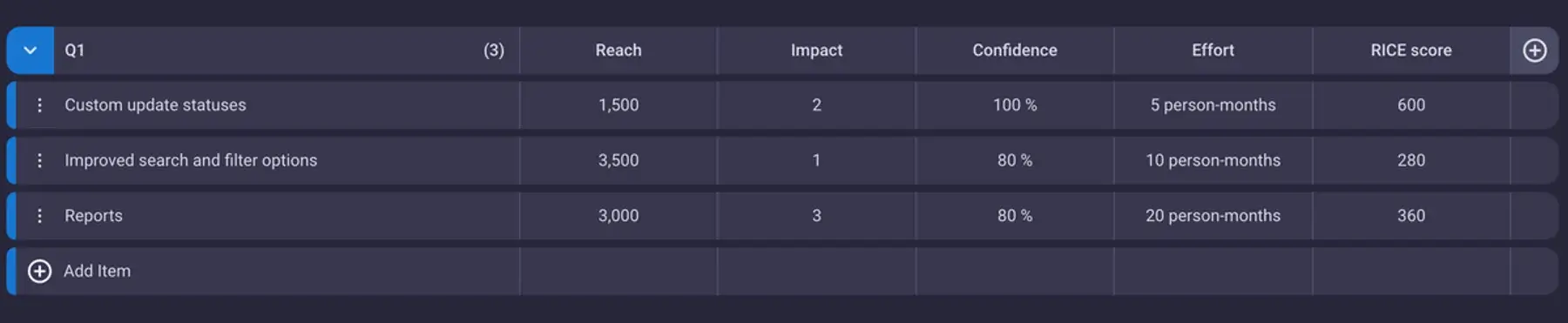
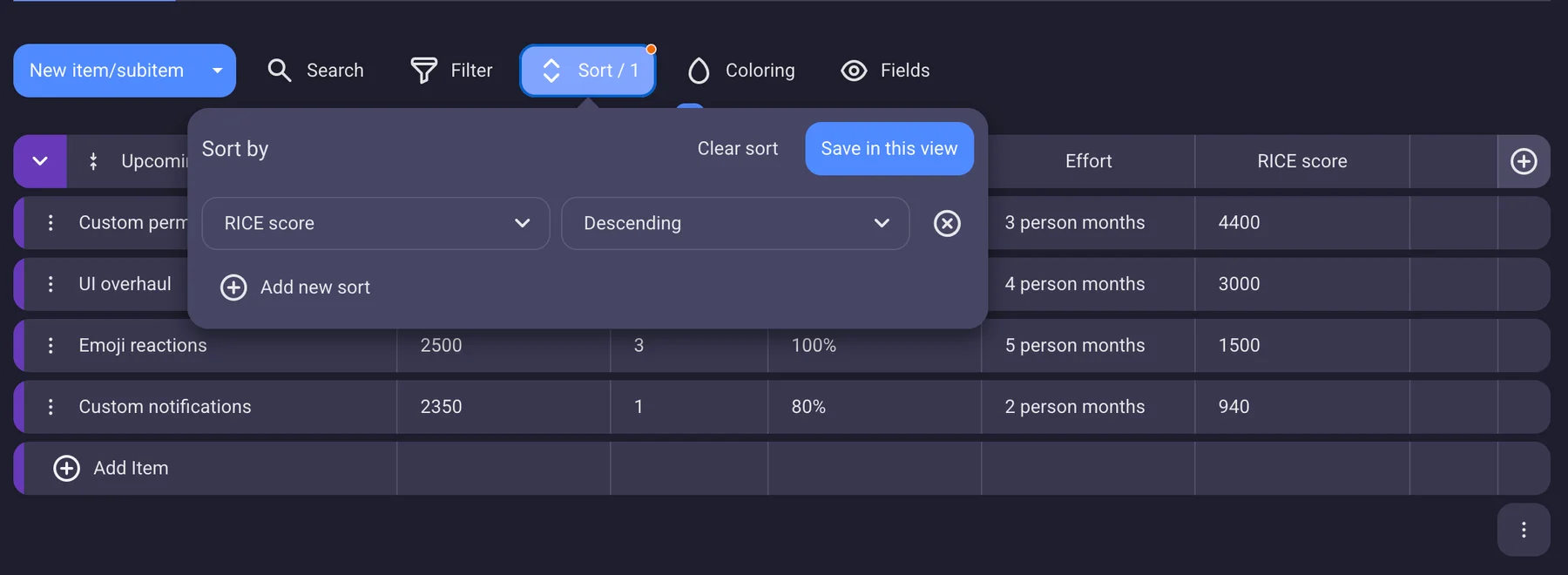
In Plaky, you can also sort & filter your project ideas according to their RICE scores to instantly recognize which projects to prioritize.
Use Plaky to calculate RICE scores
Free RICE framework template you can use
One of the easiest ways to use RICE is to set up a spreadsheet where you can automatically calculate the RICE score.
If you want to apply the RICE scoring model to your projects, here’s a free RICE matrix template you can download and customize to your needs.
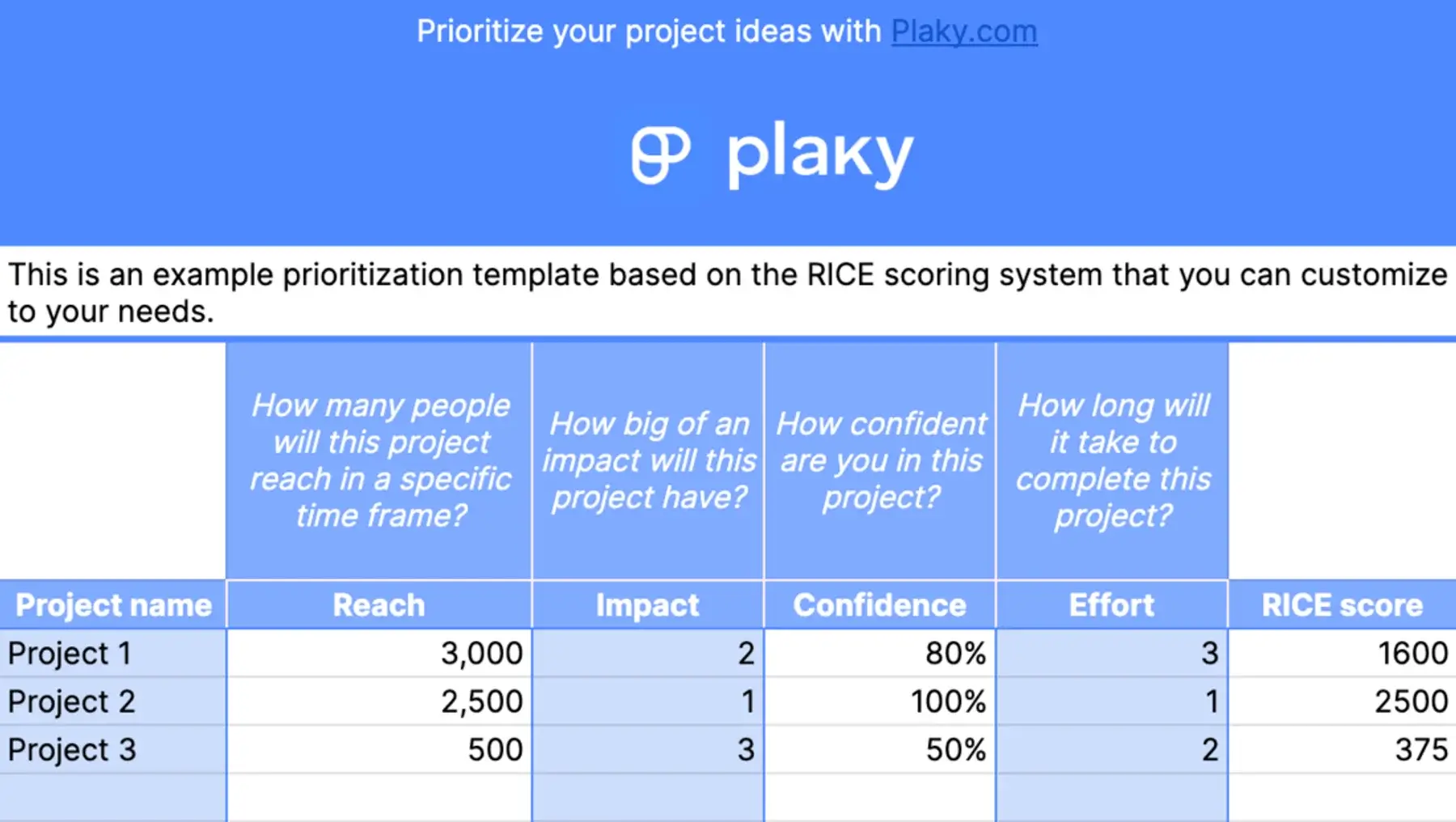
The template already contains the RICE formula, so all you have to do is fill out the matrix using your own project ideas and data. The RICE scores will be automatically calculated.
FAQs about the RICE method
Now that you know how to use RICE, let’s go over some of the most common questions asked about this scoring system.
What are the benefits of the RICE framework?
The main benefits of the RICE prioritization framework are:
- Data-driven evaluation — RICE encourages you to rely on data and evidence to make decisions, thus reducing biases and prioritizing objectively impactful ideas and initiatives.
- More effective time and resource allocation — RICE prevents you from pursuing low-impact initiatives that only waste time and resources and instead encourages you to invest them in more advantageous projects.
- Higher level of customer centricity — RICE puts more attention on customer reach and impact, favoring projects that benefit the customers and meet their wants and needs.
- Transparent prioritization — the RICE score clearly shows team members which ideas are worth pursuing and why, thus building trust and aligning the team around a common goal.
- Versatility — RICE can be adapted to fit many different contexts, industries, and businesses.
What are the drawbacks of the RICE framework?
The main drawbacks of the RICE scoring model are:
- Potential inaccuracy and inconsistency — RICE calculations can be inaccurate or inconsistent if you’re working with old data or are just guesstimating. Using a tool like Plaky can help keep you consistent. With features such as Conditional coloring, you can pinpoint low RICE scores or inaccurate inputs, or highlight the most favorable projects.
- Complexity — RICE can be difficult to implement due to the amount of data and analysis necessary to complete each project, especially if the projects are complex.
- Subjectivity — Though RICE encourages objectivity, certain factors, such as Impact and Reach, can succumb to subjectivity unless a number of stakeholders are involved in the estimation process. In Plaky, all stakeholders can be notified of changes on projects, and leave comments under items to discuss changes.
- Disregarding tech debt — Since RICE prioritizes projects based on their user reach and impact, it may make the team overlook improvements that don’t have an immediate impact on the customers but could benefit the product development process in the long run.
- Project interdependencies — certain projects must be prioritized due to their interdependencies, so their RICE scores may not be the only prioritizing factors the project team has to use.
What are the best practices for using the RICE model?
Some best practices for using the RICE framework for prioritization include:
- Defining the scoring criteria beforehand and using them consistently
- Focusing on a single goal rather than multiple objectives when calculating the RICE scores
- Taking into account resource and time dependencies between different project ideas when evaluating Effort
- Getting objective feedback by involving stakeholders in the process
- Involving the team in the decision-making process, especially when 2 or more projects have similar RICE scores
- Regularly updating the scores (and consequently, the priority of your ideas) whenever new data is available
- Using both quantitative and qualitative analysis for precision
- Leaving some margin for error, as estimates are almost never 100% accurate
According to Karol Kłaczyński, Scrum Product Owner, Scrum Master, and Head of Product at Brand24, cross-functional analysis should be the focus here:

“It’s crucial to involve cross-functional teams in the scoring process to get diverse perspectives. This way, you’re not just coming from a product-centric viewpoint but also considering marketing, sales, and customer success angles.”
He also adds that the key to successfully using the RICE framework is to be as objective as possible when scoring each component.
Collaborate across teams with Plaky
What are some alternatives to the RICE prioritization method?
Some widely used alternatives to the RICE scoring framework include prioritization methods such as:
- The Eisenhower Matrix — a prioritization tool that organizes initiatives by urgency and importance, categorizing them into 4 quadrants: Do, Decide, Delegate, and Eliminate
- ICE method — a framework similar to RICE that prioritizes projects based on their numerical value while considering 3 factors: Impact, Confidence, and Ease
- Kano Model — a scoring model that assesses initiatives by comparing how likely they are to satisfy customers against the costs of their implementation
- MoSCoW analysis — a prioritization method that organizes ideas into 4 categories: must-have, should-have, could-have, and won’t-have
- Weighted Shortest Job First (WSJF) — a tool that prioritizes initiatives with the highest economic impact and the shortest completion period
- Value vs. effort matrix — a prioritization technique that weighs initiatives by considering their potential value and how much effort it would take to complete them
- Opportunity scoring — a prioritization method that considers ideas customers believe are important but currently disappointing
- Weighted scoring — a numerical scoring model that objectively prioritizes ideas or actions based on a set of criteria and their assigned weight values
All of these methods come with certain pros and cons, so there’s no telling which one is truly the best.
What is the difference between RICE and WSJF?
The main difference between RICE and WSJF (Weighted Shortest Job First) is that RICE focuses more on impact, while WSJF emphasizes economic value.
The WSJF prioritization method sequences tasks, projects, ideas, and similar based on maximum economic benefit. Thus, it uses different parameters than RICE, such as:
- Cost of delay (CoD) — the money you lose by delaying the completion of a job
- Job duration or size (JST) — estimated time needed to complete a job or the job’s size if you don’t know how long the job will take
The WSJF formula is straightforward — CoD/JST. However, the method is more complex to apply than RICE as CoD is a sum of 3 different estimates:
- Business or user value
- Time criticality
- Risk reduction and/or opportunity enablement
What is the difference between the ICE and RICE frameworks?
The main difference between the RICE prioritization process and the ICE scoring model is that RICE takes Reach and Effort into account, while ICE forgoes Reach and considers Ease instead of Effort.
Both methods serve to prioritize ideas.
However, the formula for the ICE method — Impact x Confidence x Ease — is easier to calculate, making it less time-consuming to implement.
Is the RICE framework still relevant?
The RICE matrix remains a highly relevant standard because it provides a shared vocabulary for product teams.
While some advanced teams supplement it with weighted scoring to address specific nuances, the RICE framework is still one of the most effective ways to force objective trade-offs and justify roadmap decisions with data.

Try Plaky for effective RICE analysis and realistic idea prioritization
The RICE framework supports better decision-making and enables project teams to confidently prioritize ideas based on both data and their own insights.
If you are looking for a tool to help you implement the RICE framework into your project management, Plaky is the right tool for you!
With Plaky, you can:
- Create custom fields to track RICE parameters.
- Collaborate with team members and stakeholders with comments and @mentions.
- Standardize and analyse data easily with customizable fields and multiple project views.
- Track and organize your projects with Spaces, Boards, Items, and Subitems.
And, with Plaky’s affordable pricing and flexible free and paid plans, you’ll be sure to find what you need for your teams and projects.
Sign up for a free Plaky account today, and prioritize with ease!
How we reviewed this post: Our writers & editors monitor the posts and update them when new information becomes available, to keep them fresh and relevant.